
Entrance and door mats — 18 colourways →
Cut to the opening, pattern centred and border even all round. This is where a mat takes the most abuse, so the bound edge is the usual choice here.

Request a quote →Sample book and A4 swatches available — Request a swatch kit · stock items carry no MOQ
texlymat® floormats, runners and rugs are finished pieces in woven vinyl with a high-tenacity polyester core: cut and finished with a bound edge or self binding. UV-stabilised and hose-cleanable, so they can stay outside on patios and balconies and come back inside for entrances, hallways, kitchens and bars. Made to order as mats, runners and area rugs. They are used at entrances and in hallways, kitchens and bars, bathrooms, and on patios and balconies.
| Property | Specification | Test method |
|---|---|---|
| Material | Woven vinyl with a high-tenacity polyester core: 1.0 mm woven vinyl face on a 3.0 mm PVC foam backing | — |
| Surface | 1.0 mm woven vinyl | — |
| Backing | 3.0 mm PVC foam | — |
| Total thickness | 4 mm | ISO 1765 |
| Total weight | 2,400 gsm (average) | ISO 8543 |
| Format | Finished, ready-to-use door mats, area rugs, runners and patio mats | — |
| Runner width | 60–90 cm (2–3 ft) | — |
| Runner length | 180–430 cm (6–14 ft) | — |
| Custom sizes | Any customer size, including patio mats | — |
| Edge finish | Knife cut as standard, self-binding on heavier edges | — |
| Floor show | Allow 10–13 cm (4–5 in) of floor showing on all four sides | — |
| Wear classification | Class 23/33, heavy domestic / heavy commercial | EN 1307:2014+A3:2018 / ISO 10974 |
| CE marking | Certificate of Conformity No. 156 | EN 14041, see Certifications |
| UV stability | UV-stabilised, designed for in-and-outdoor use | — |
| Yarn | Solution-dyed, so the colour runs through the yarn | — |
| Cleaning | Warm soapy water and rinse with clean water; hose off outdoor mats | — |
| Product standard | Woven vinyl roll floor covering | EN 1307:2014+A3:2018 |
Specifications are taken from the official specification sheet for this product line. Items shown with a dash are quoted per project; ask us for the current figure.

Mats and runners are cut from the 200 cm roll (±1%, EN 426) to the length the space needs, with a bound or self-bound edge. A hotel corridor runner usually stops a metre short of each end, so it can be lifted for cleaning without dragging the whole length.
Rugs are cut from the same roll, so the size is limited by the roll width rather than by a quantity. A 200 cm roll takes a rug up to 200 cm in one direction and any length in the other, which covers most bedroom, seating and entrance sizes.
| Property | Value |
|---|---|
| Roll width | 200 cm ±1% (EN 426) |
| Length | Cut to order — runners and rugs made to a drawing |
| Edges | Bound or self-bound; overlocked on curved shapes |
| Thickness and weight | 4 mm / 2,400 g/m² |
| Backing | 3.0 mm PVC foam, 4 mm in total |
Six application categories run through the same cutting and edging lines. Mats are cut to the opening in both directions; runners are cut to the length of the room. Three categories are photographed, three are still to be shot.
Cut to the opening, pattern centred and border even all round. This is where a mat takes the most abuse, so the bound edge is the usual choice here.

One length down the corridor, usually stopping a metre short of each end so it can be lifted for cleaning without dragging the whole run.

Cut to the counter run. Wipe or hose it down, and the foam backing keeps it flat where a mat in front of a sink tends to curl.
The same weave cut to a size instead of laid wall to wall. A rug changes the character of a floor without replacing it, and it can be lifted and moved.
UV-stabilised yarn and a face that does not take up water, so the mat can stay out through the season. Stand it up to drain after heavy rain.
A surface that does not absorb water, cut to the space, where a textile mat would stay damp.
Colour numbers and names follow the sample book. 47 colourways are photographed: 18 cut as mats and 29 as runners. A colourway can be run in either format — the backing and the edge decide the format, not the pattern.


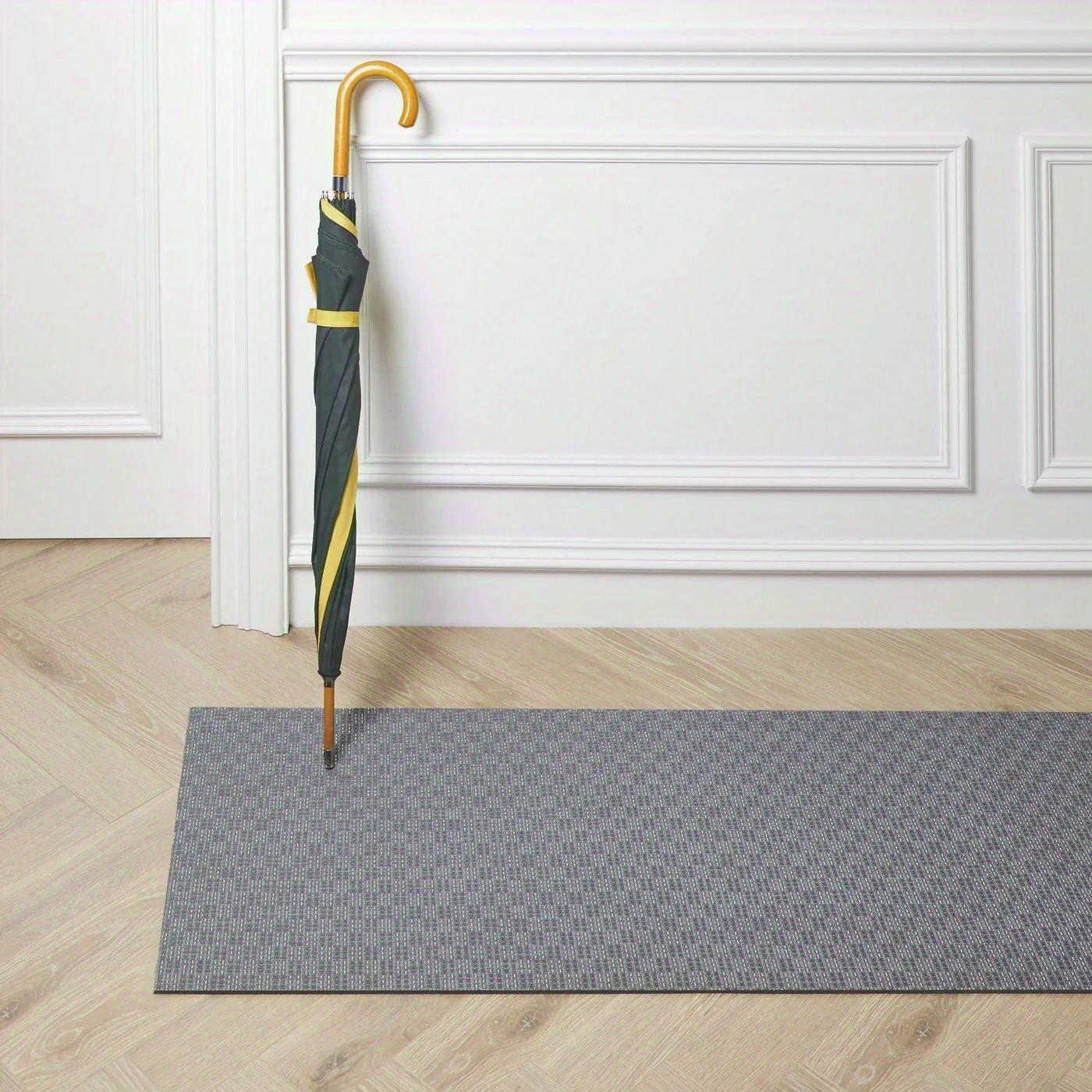

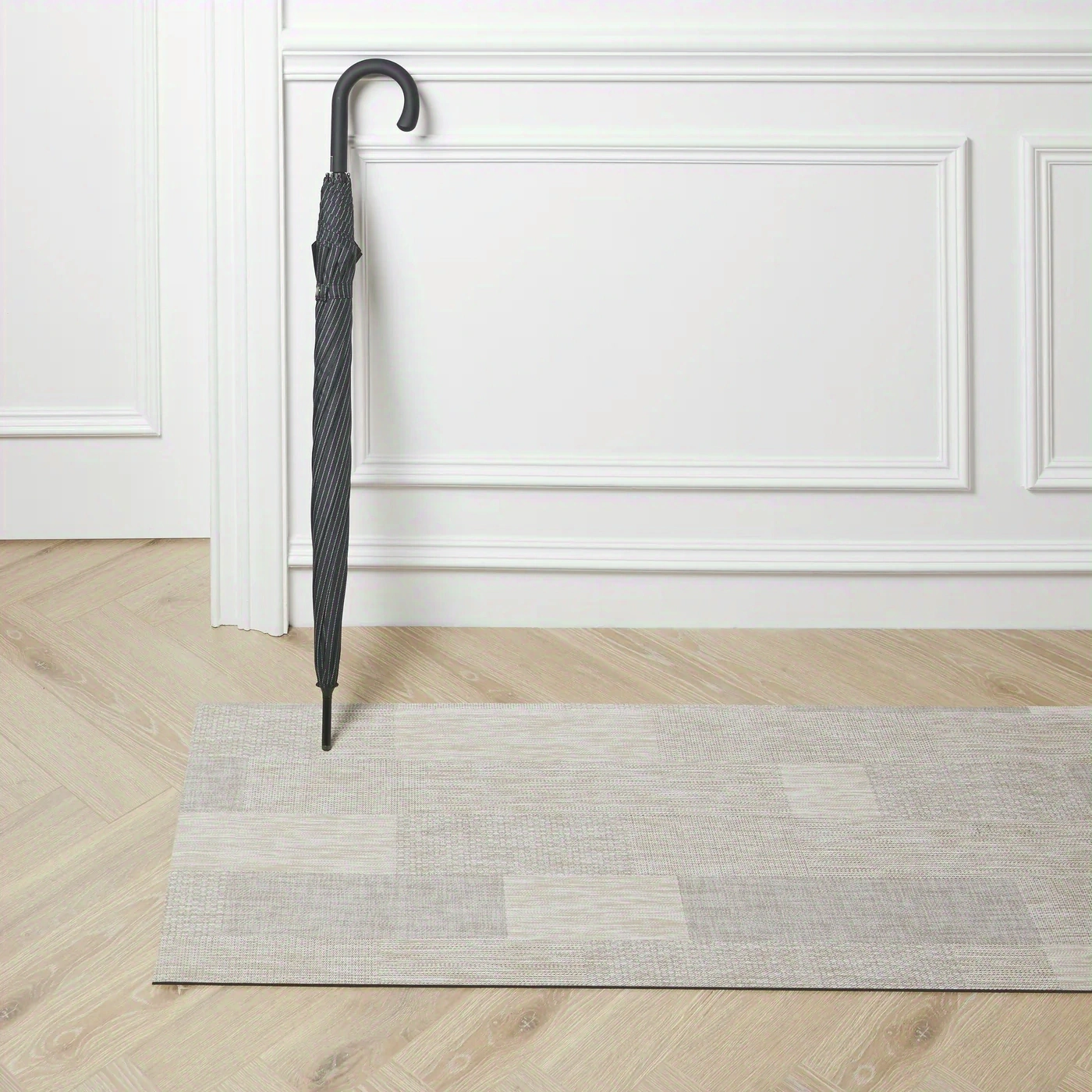

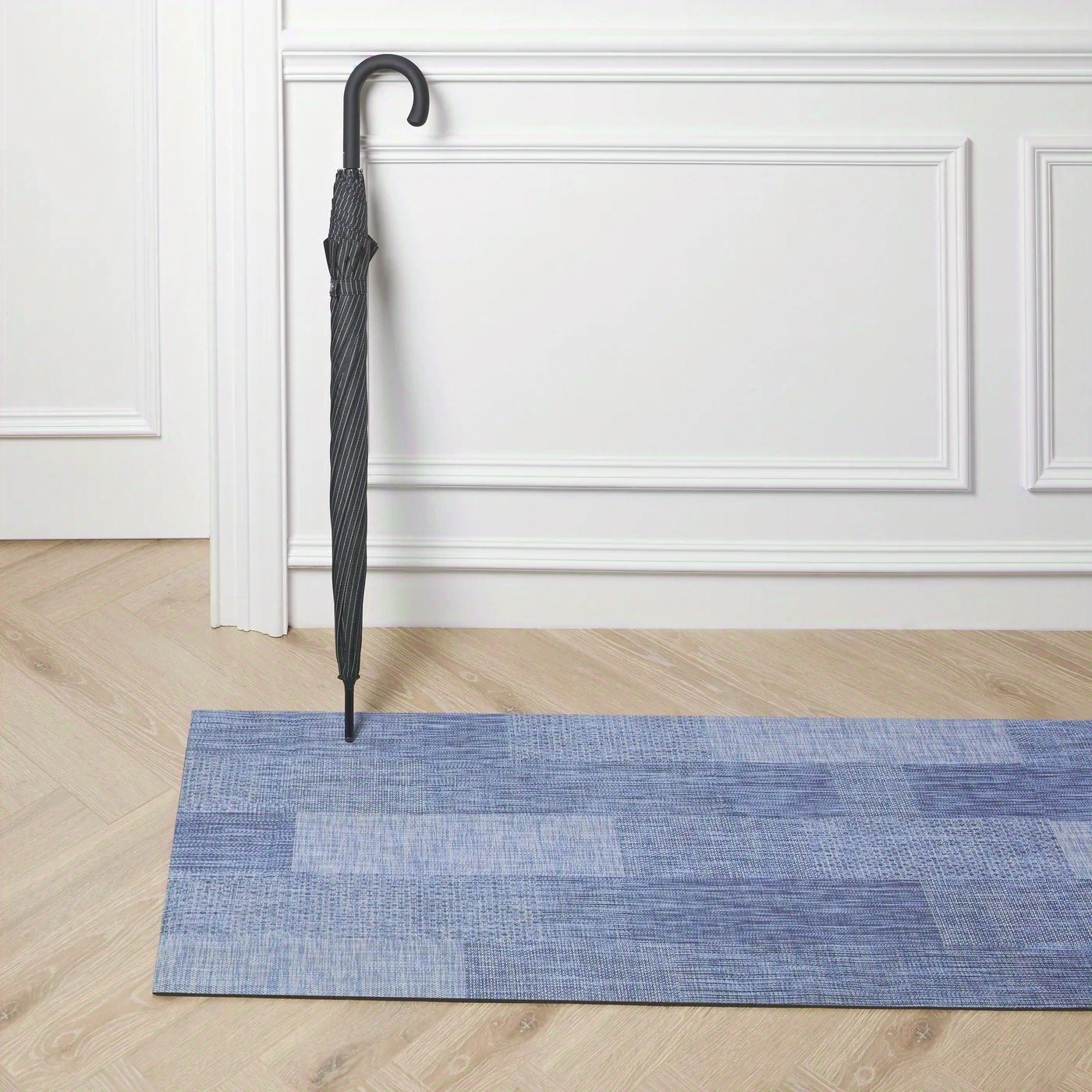

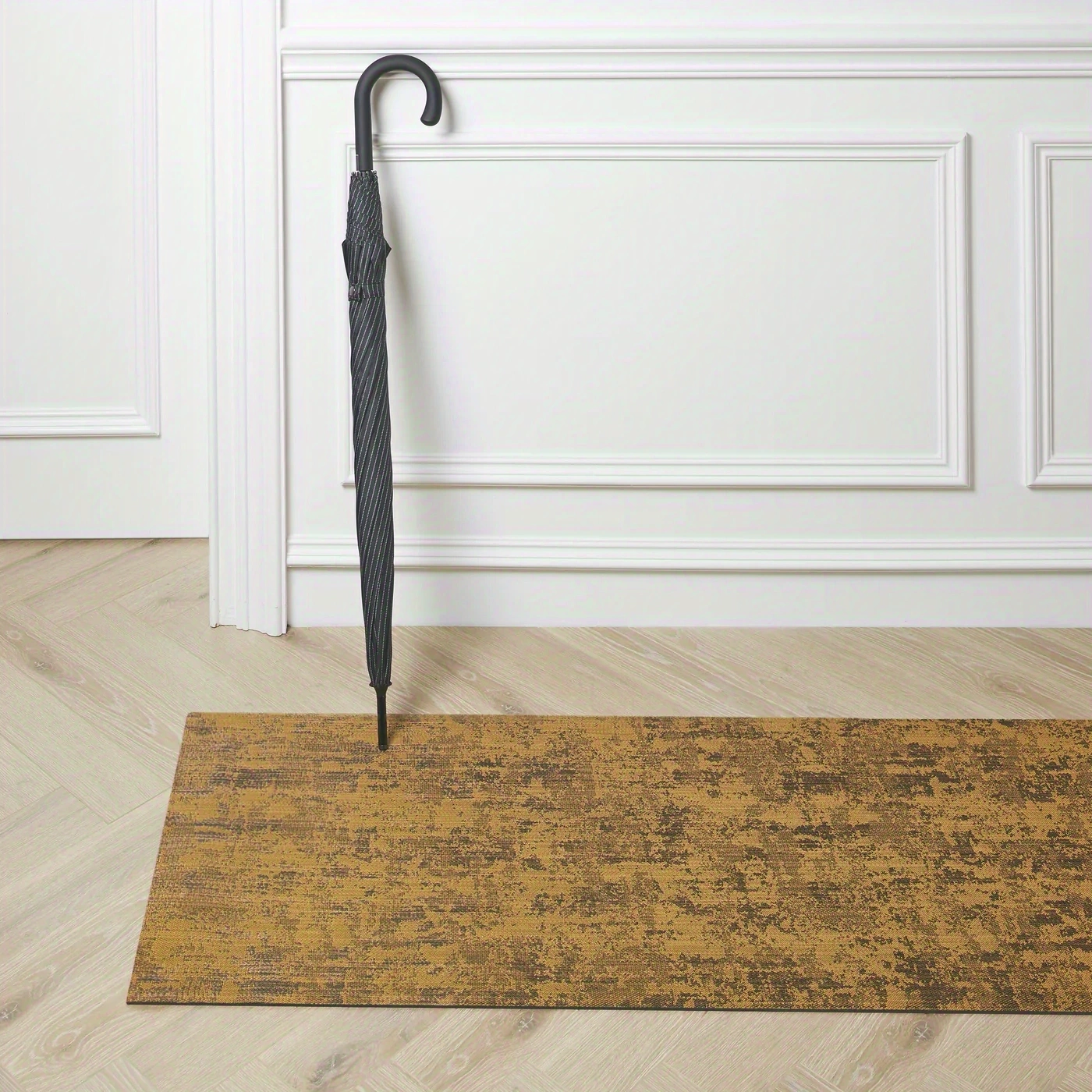

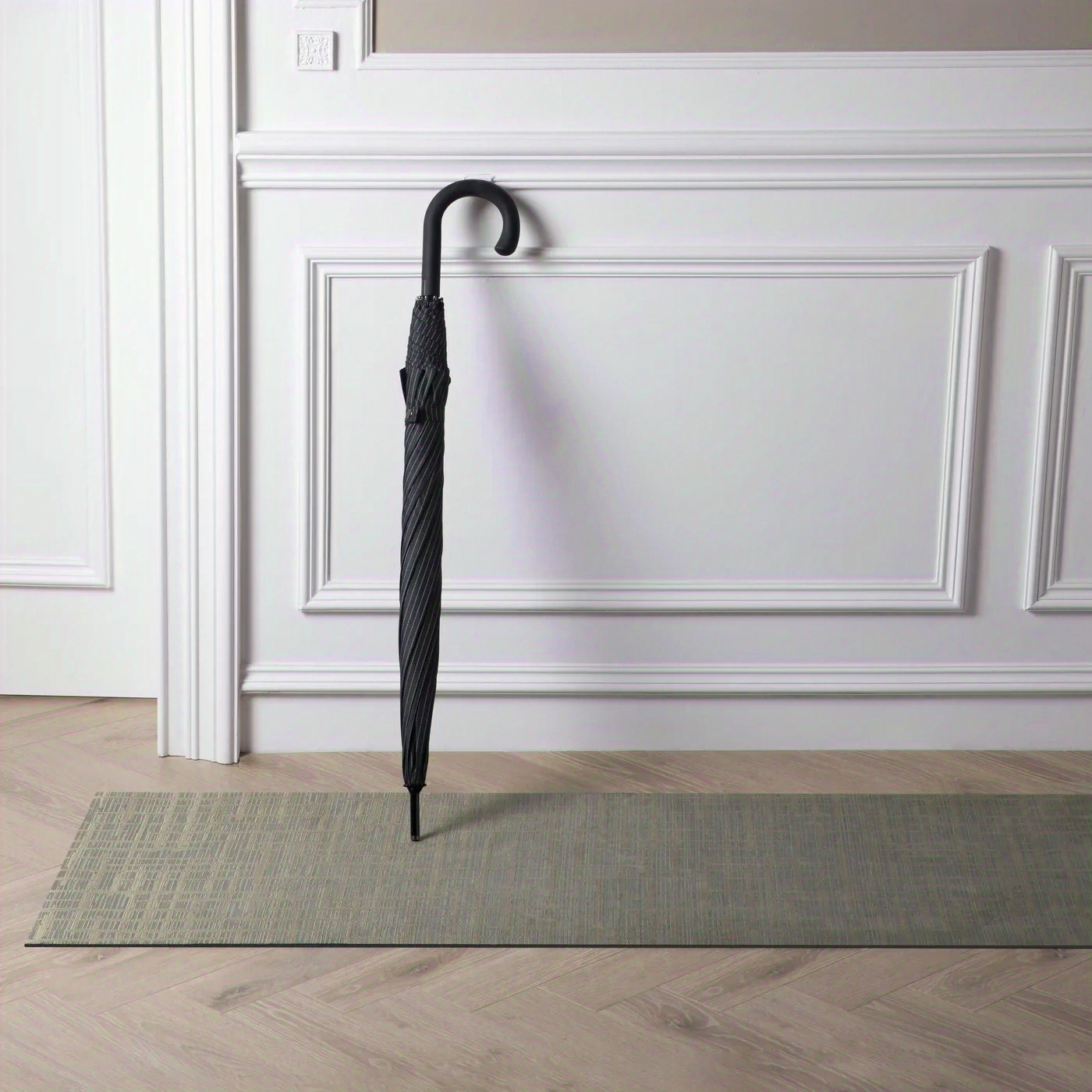

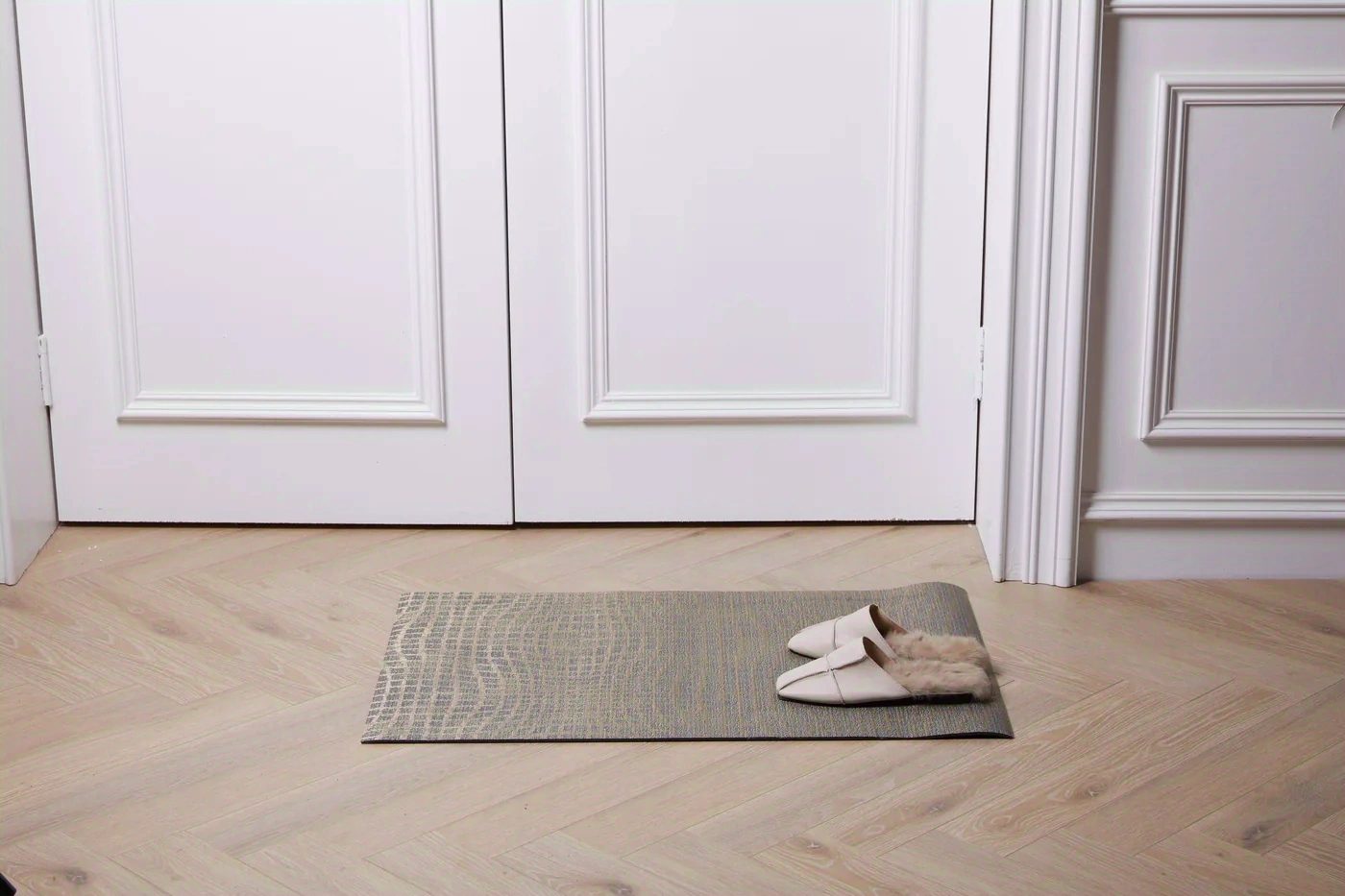

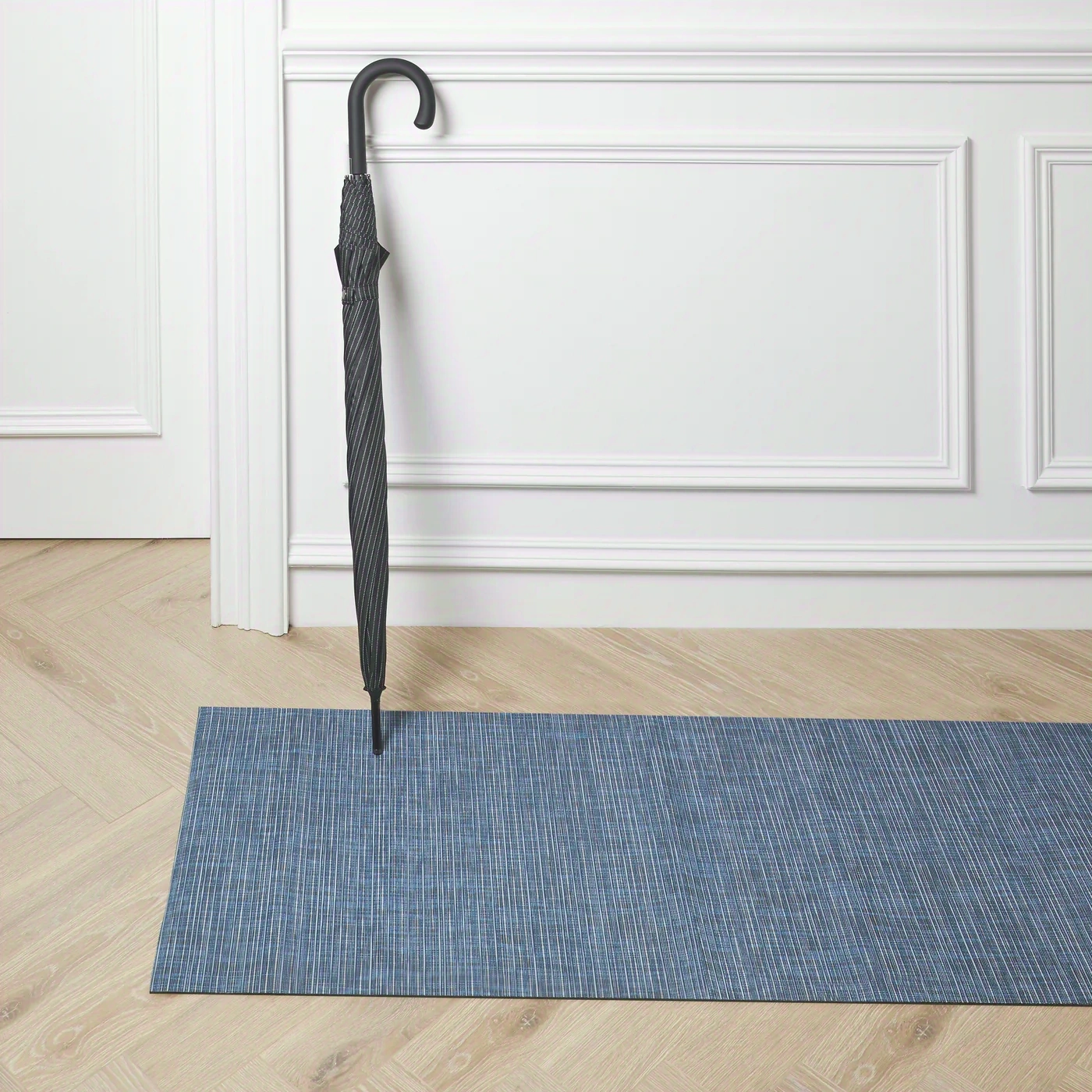

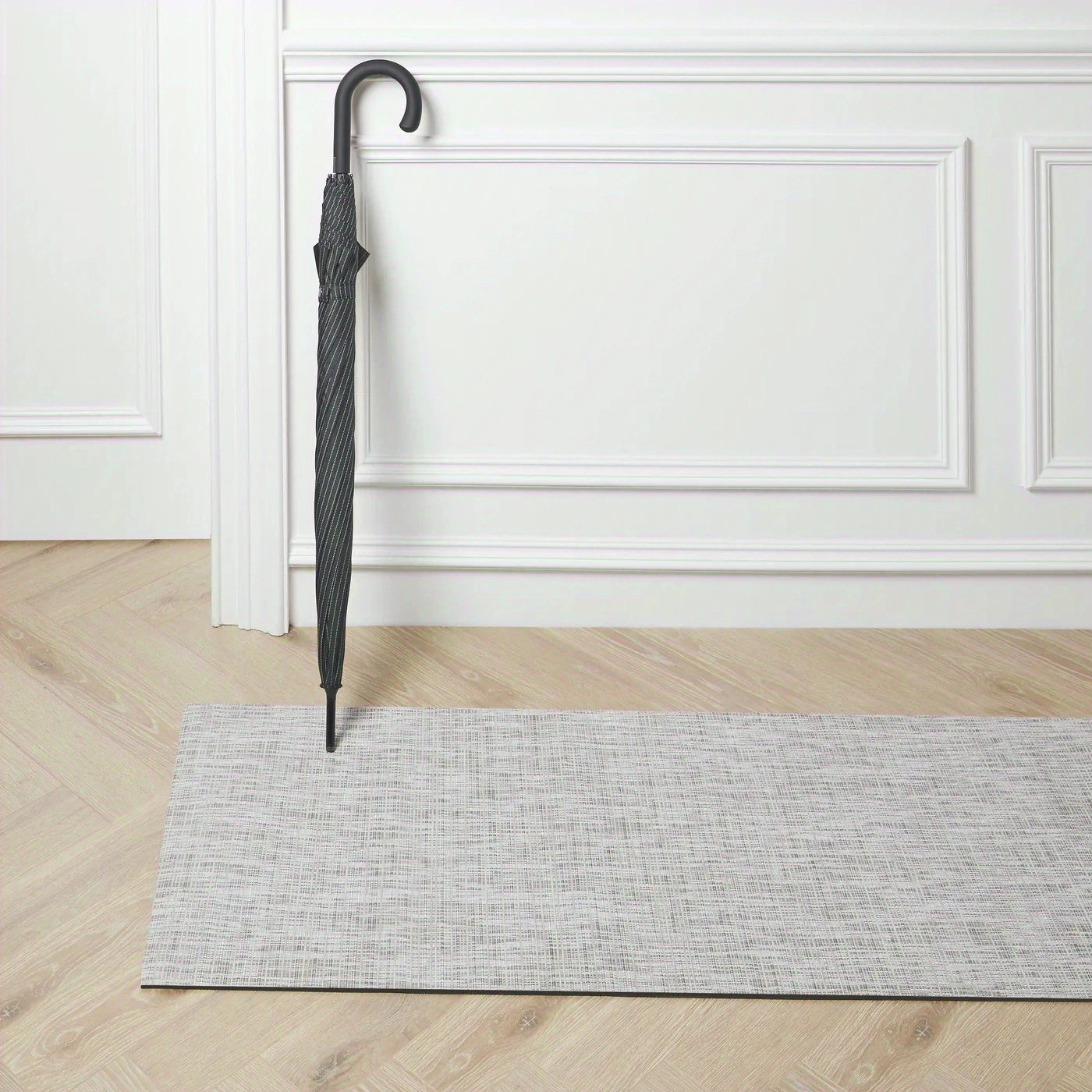

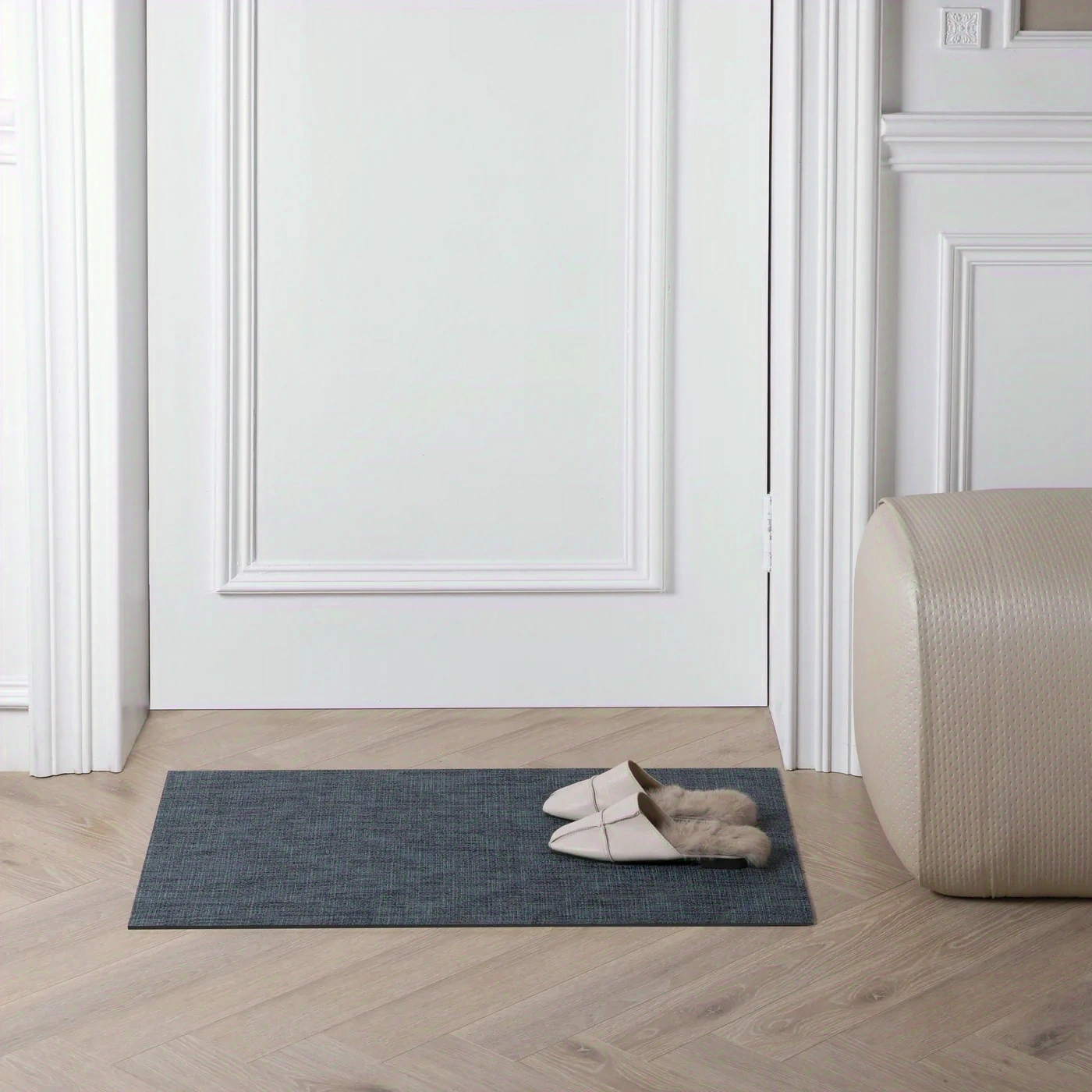

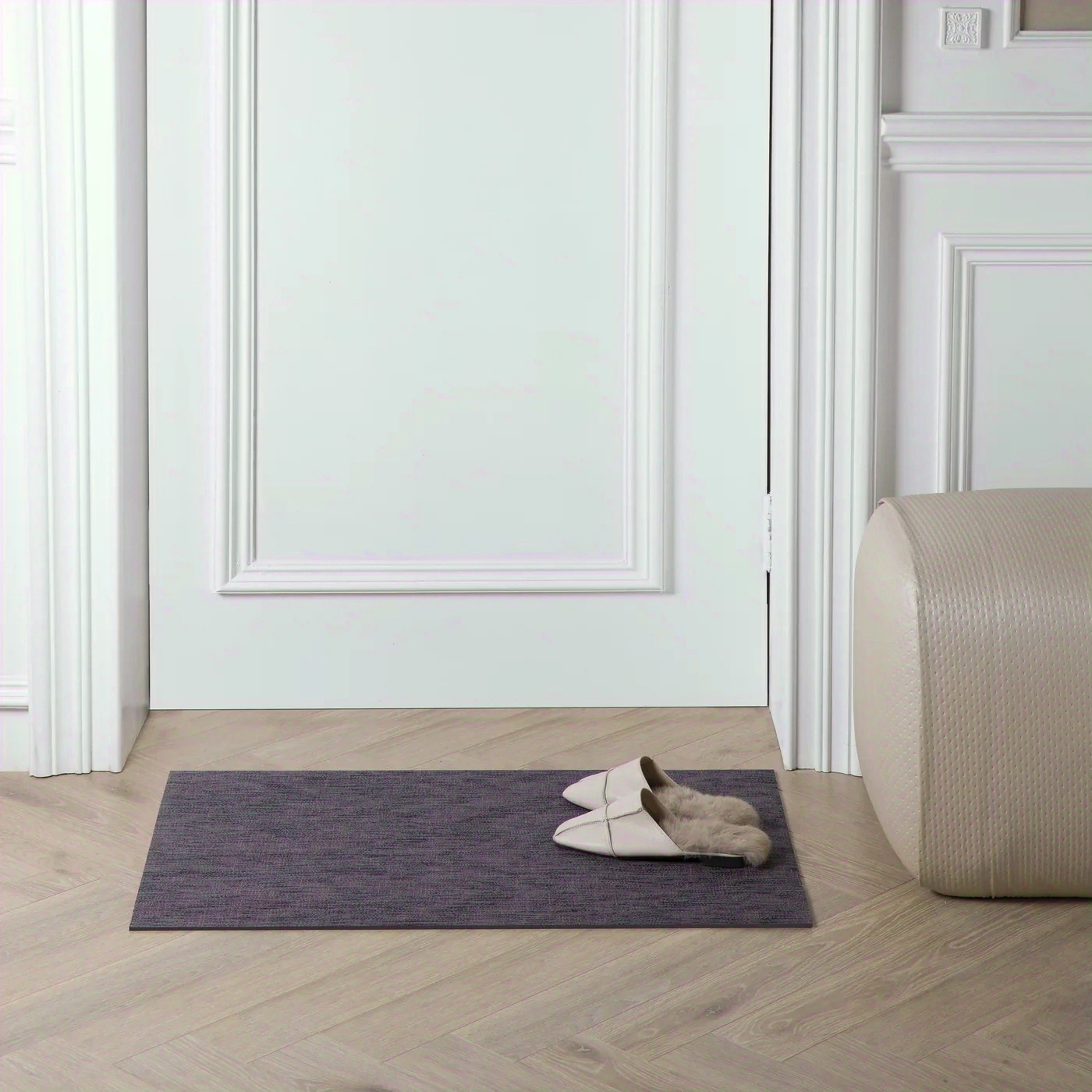

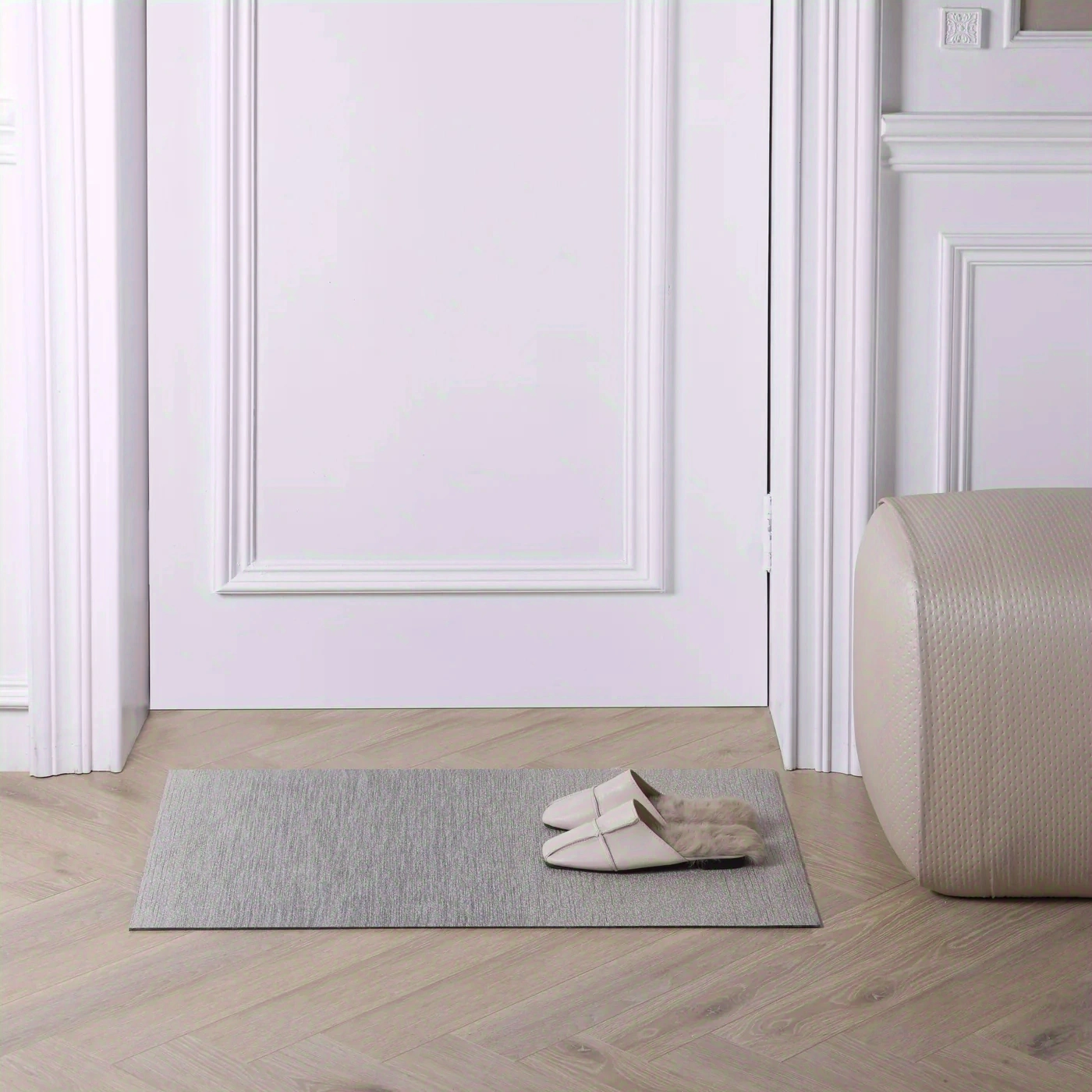

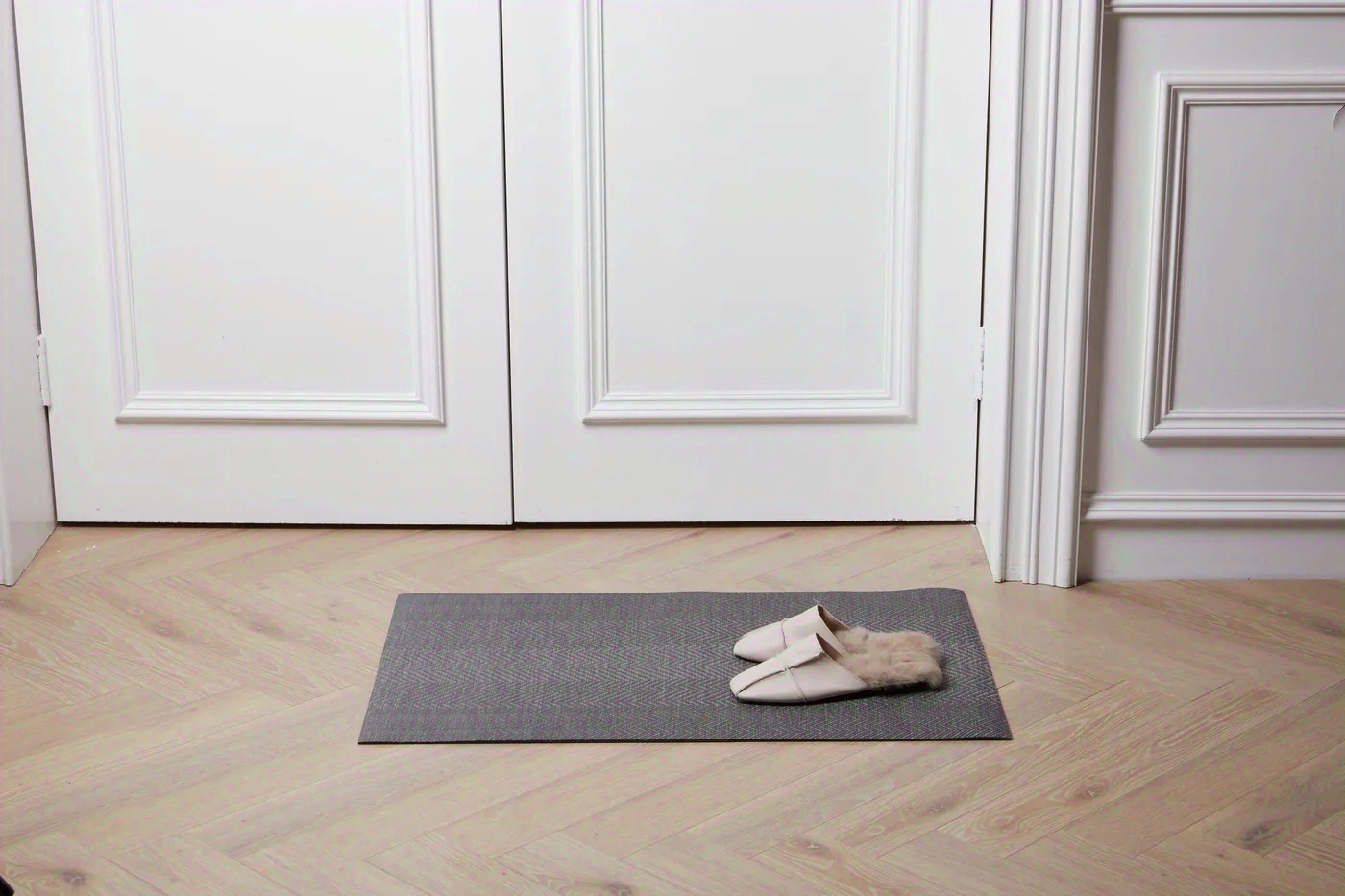

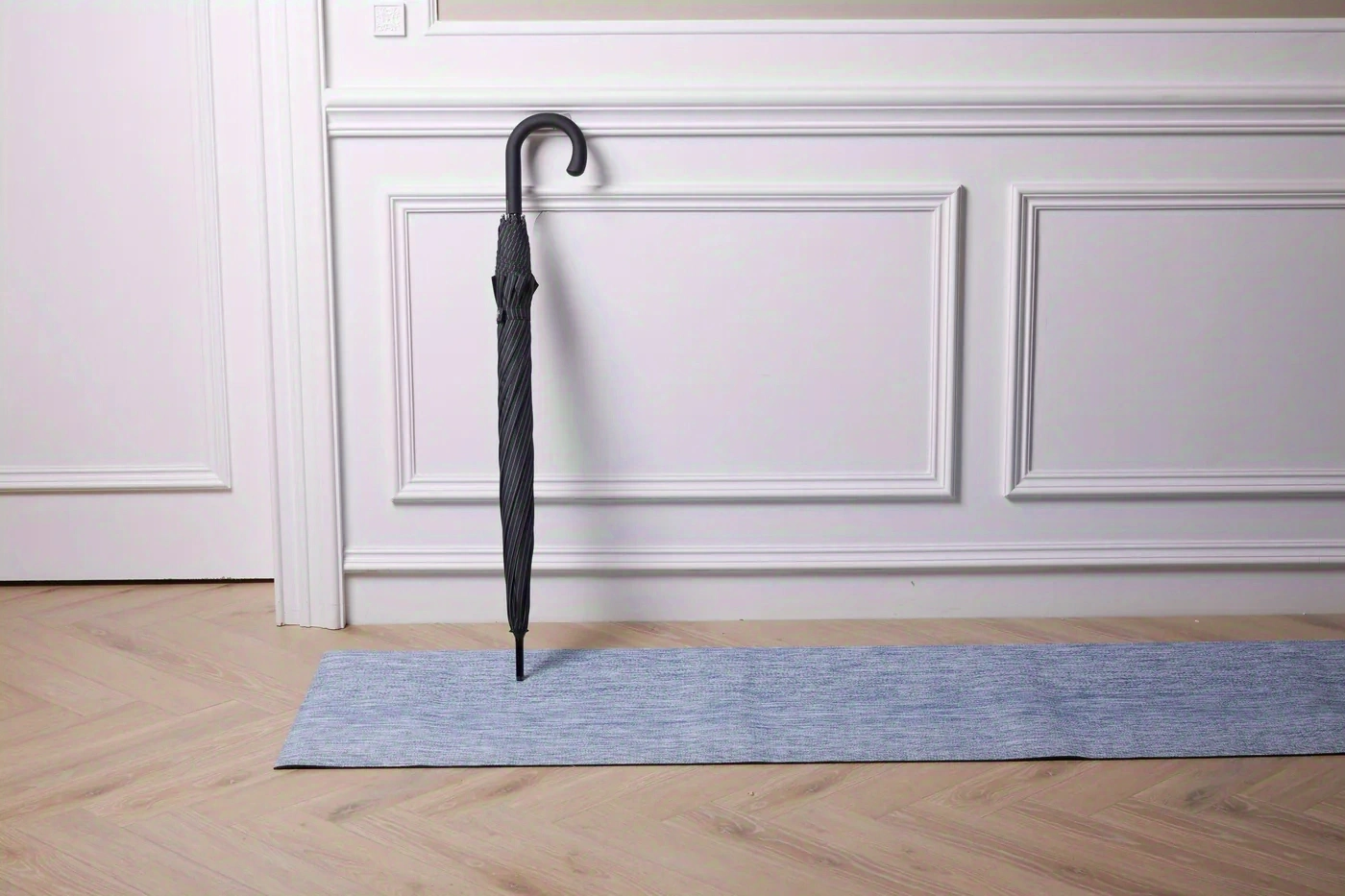

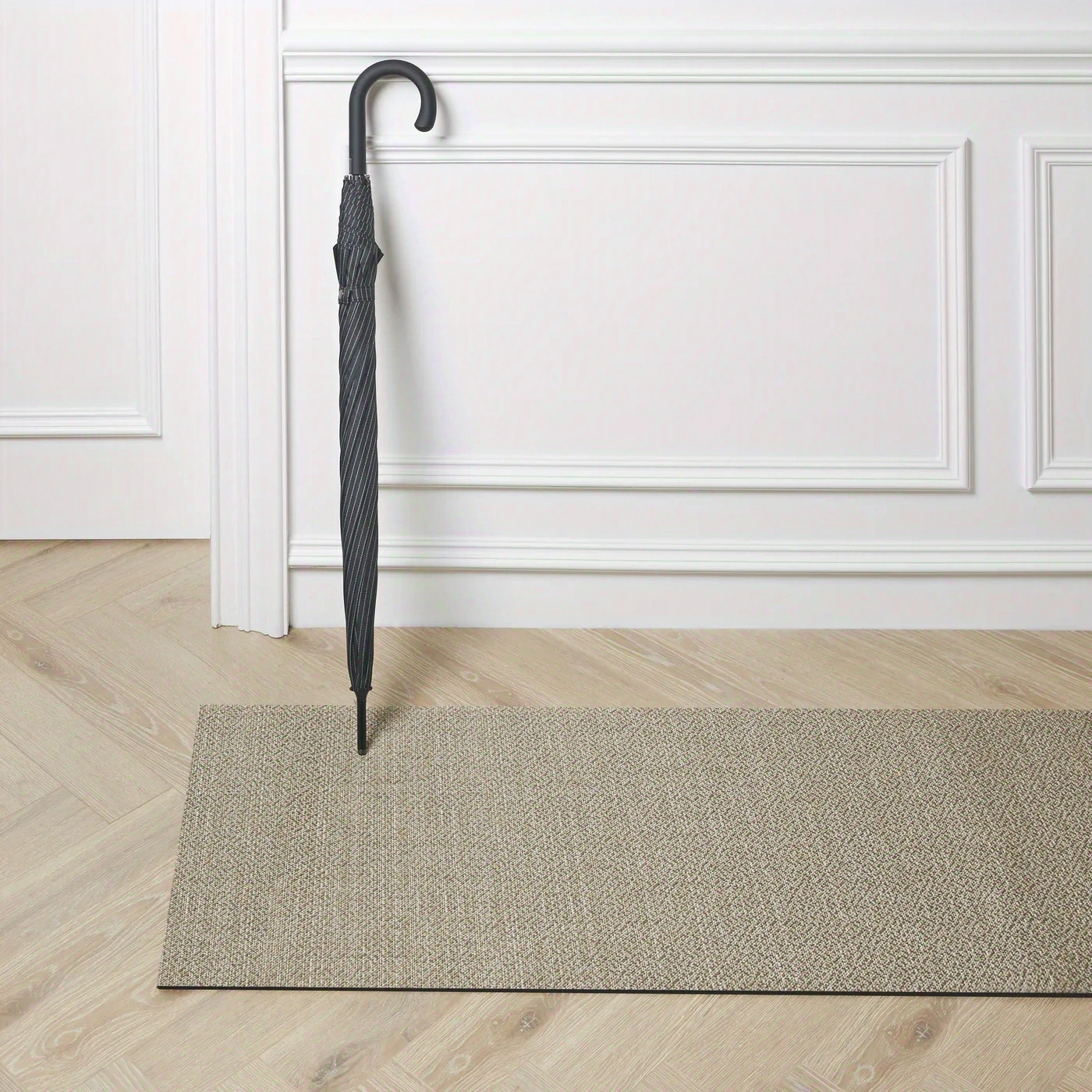

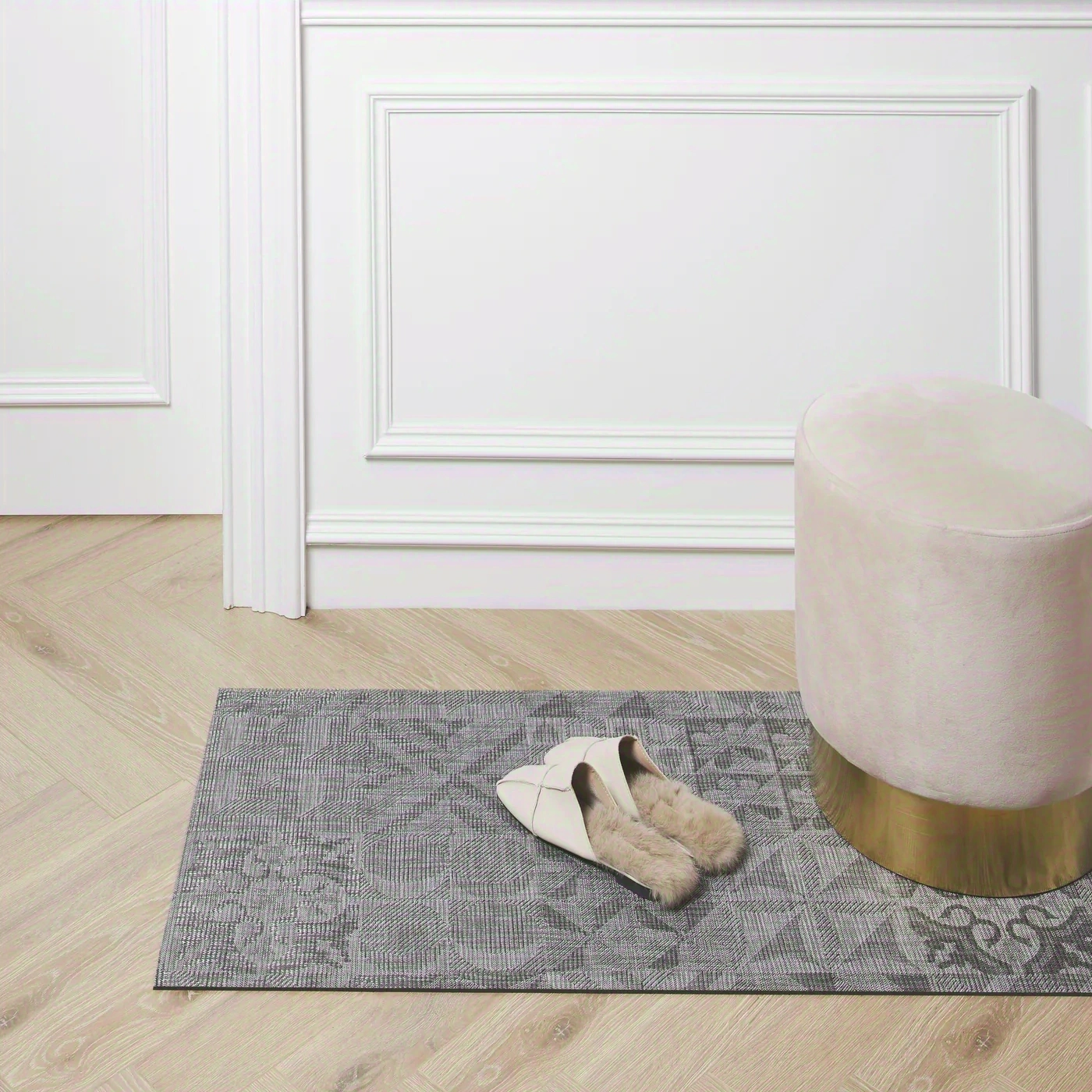

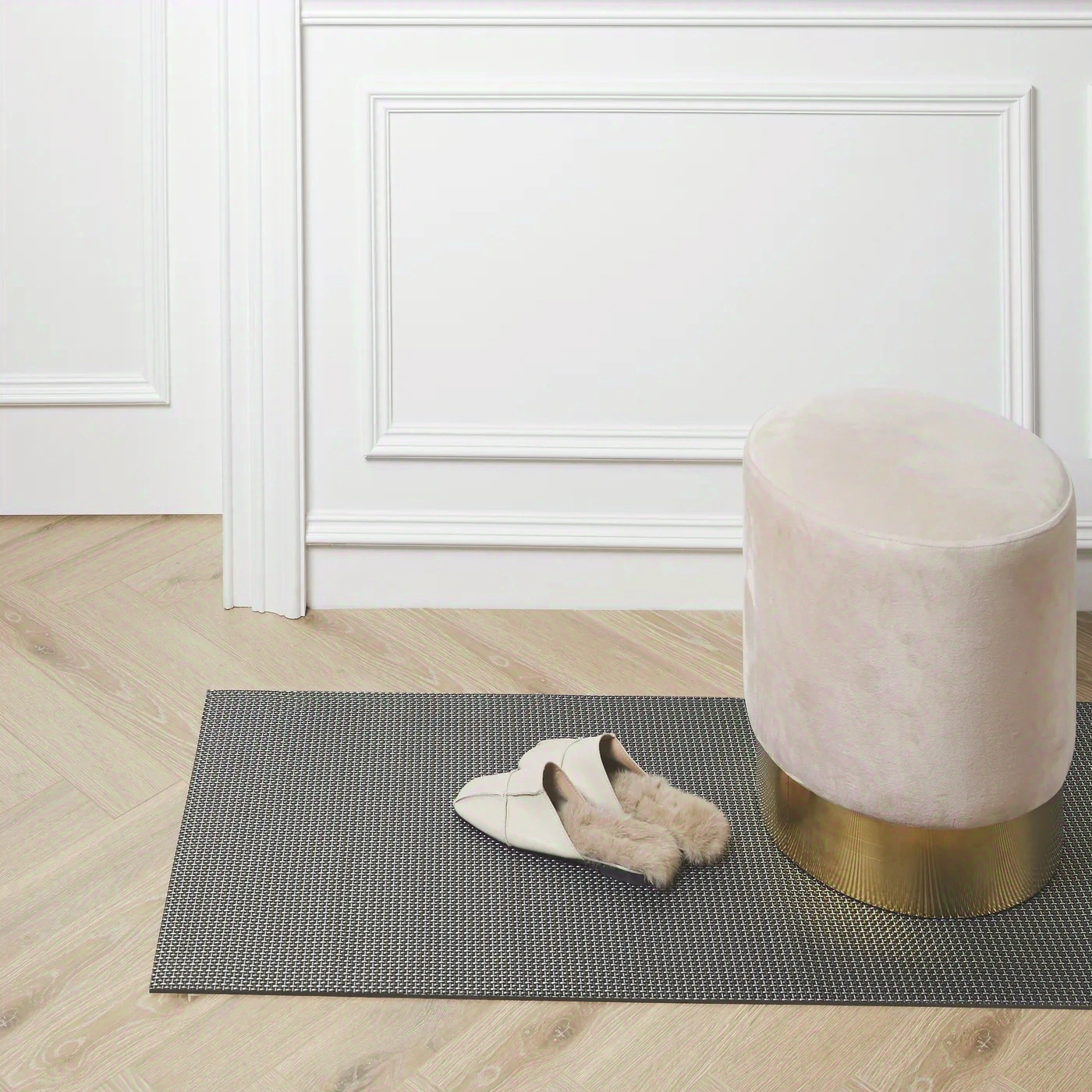


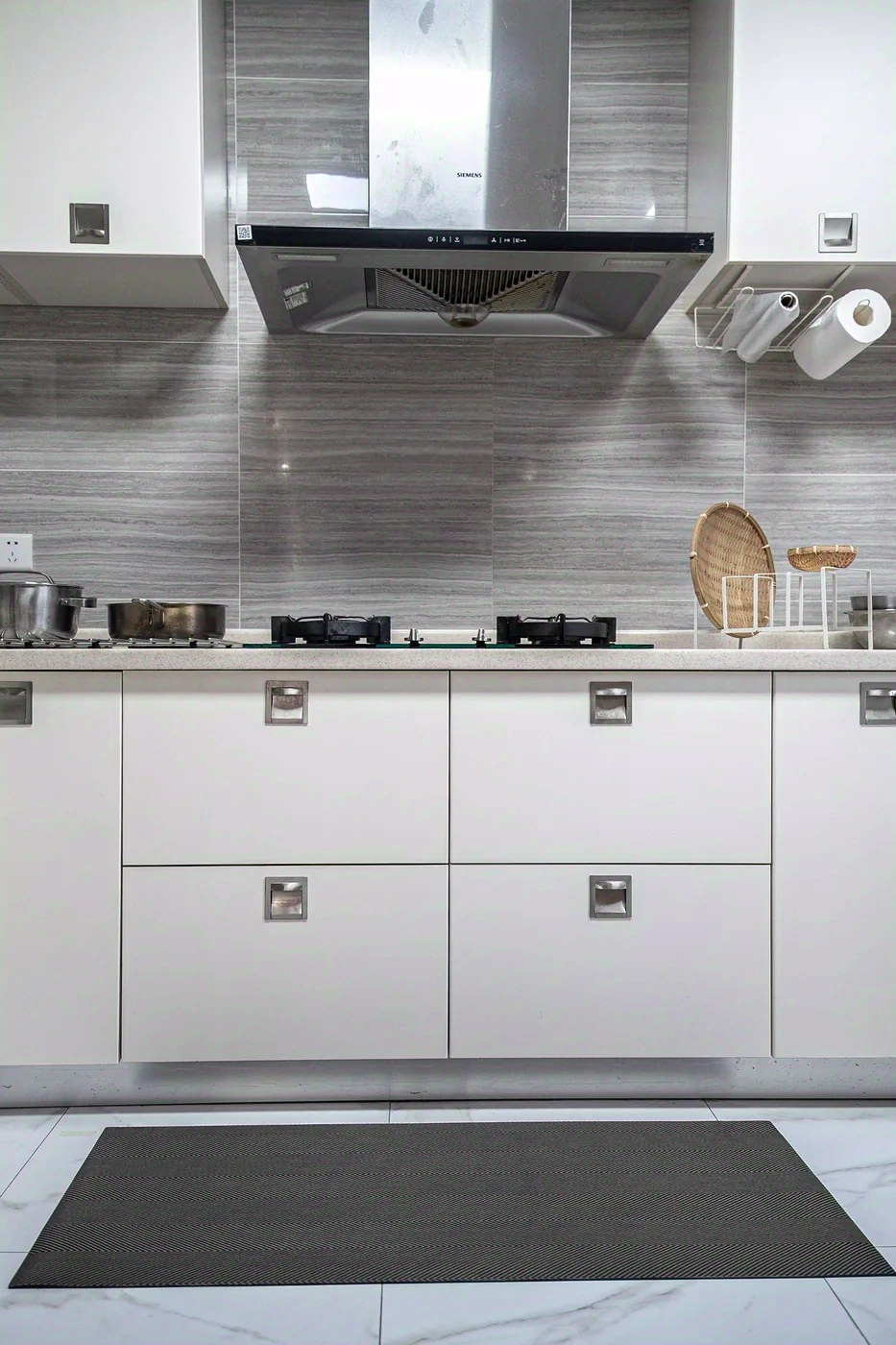
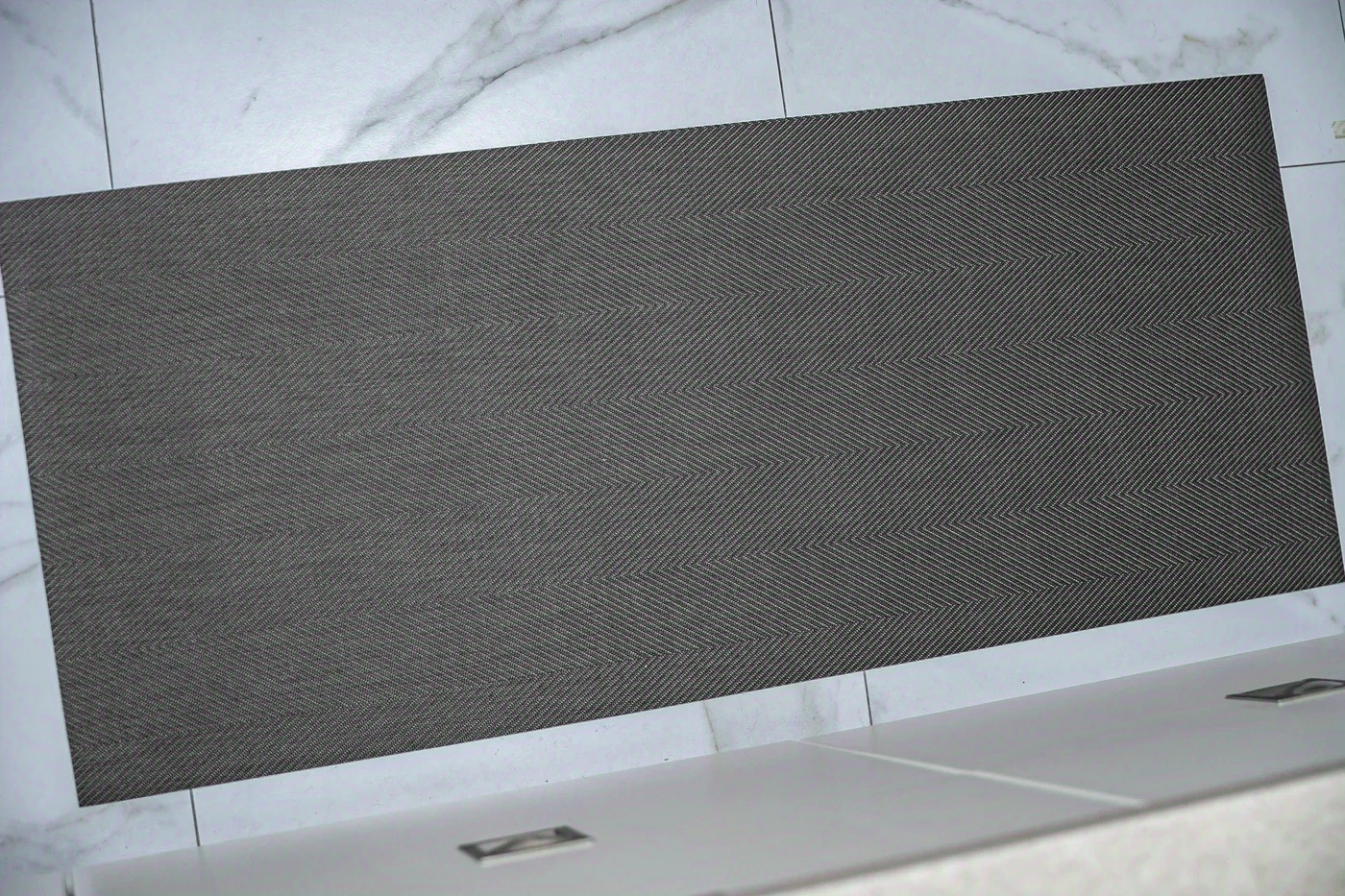
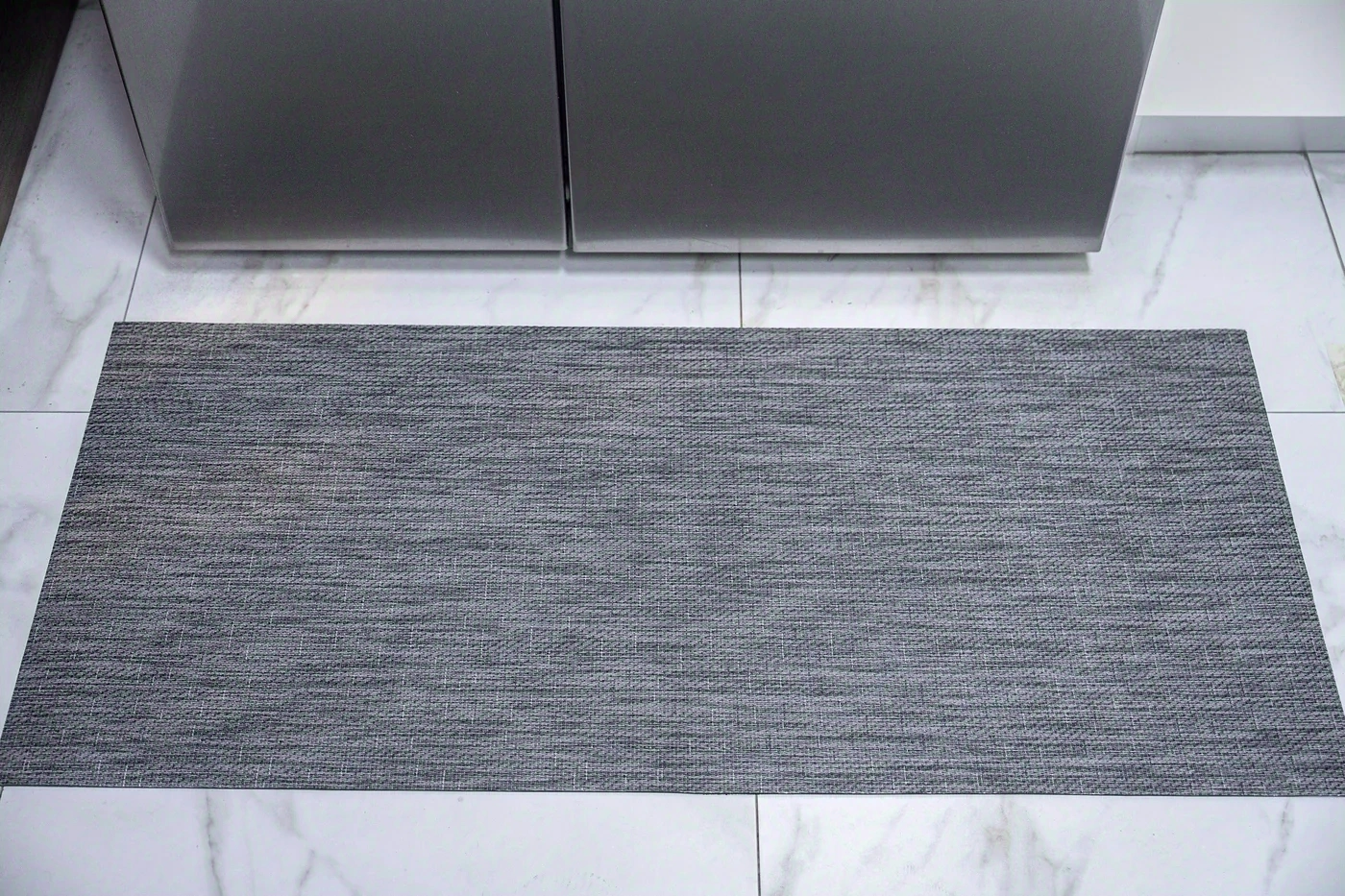


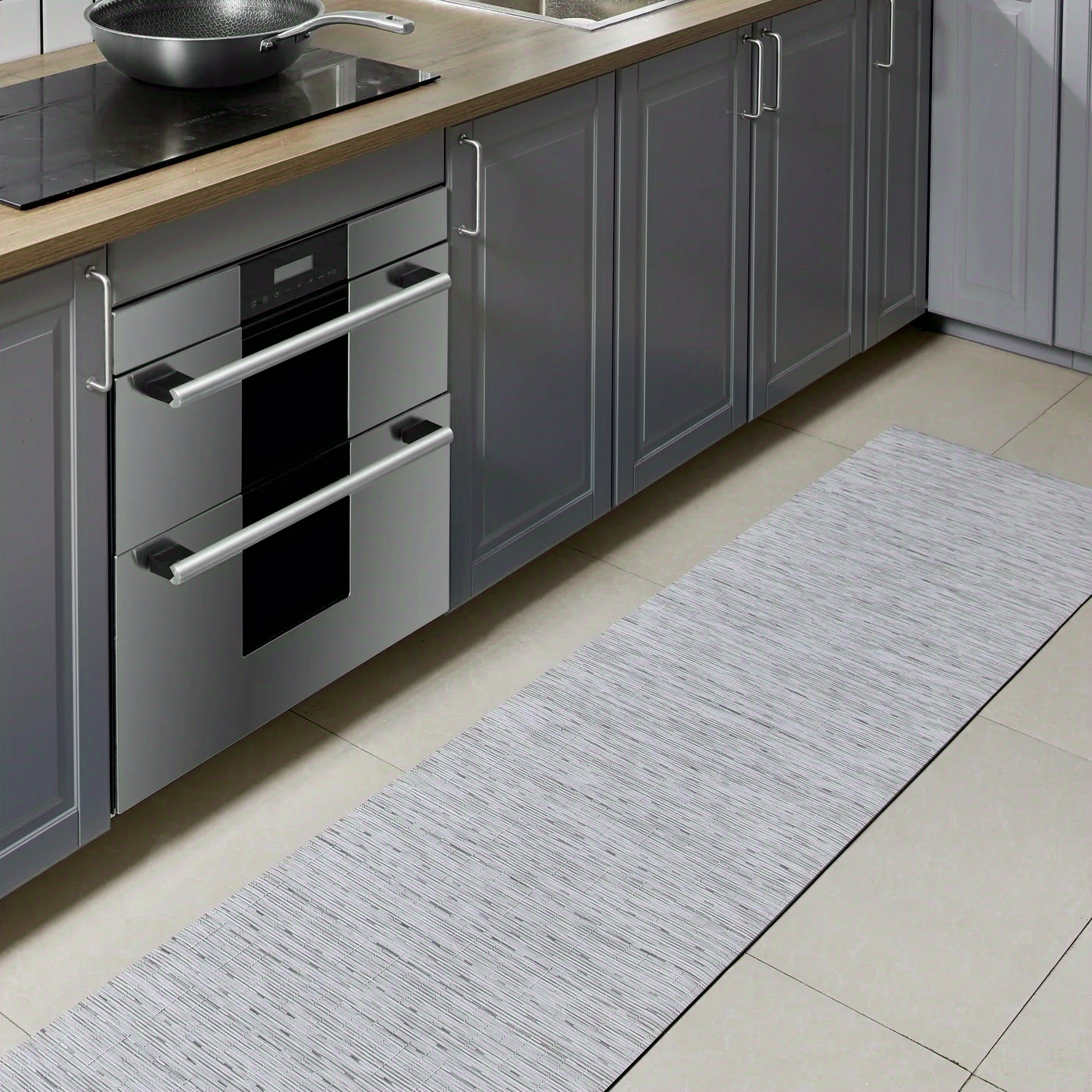


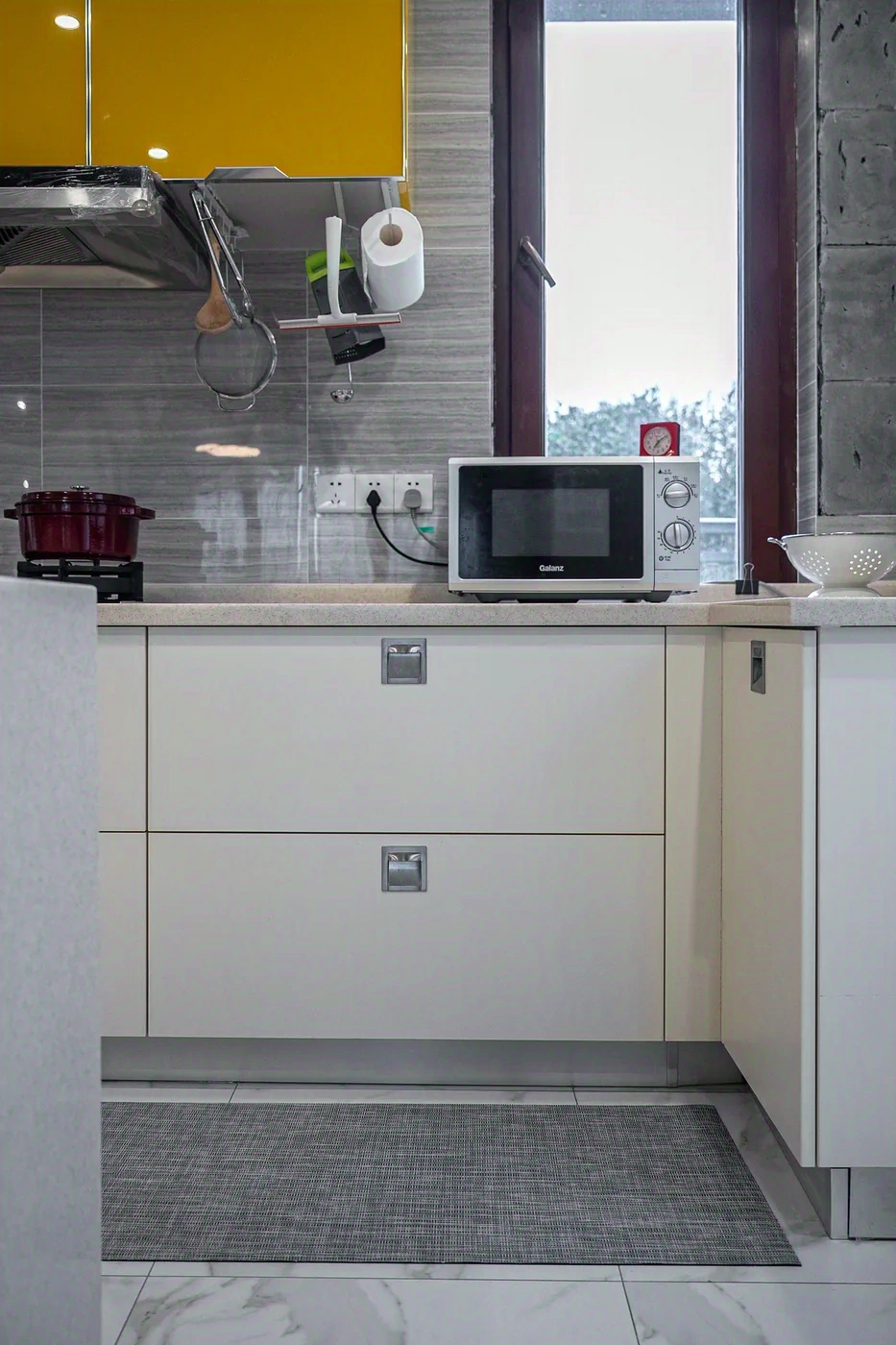


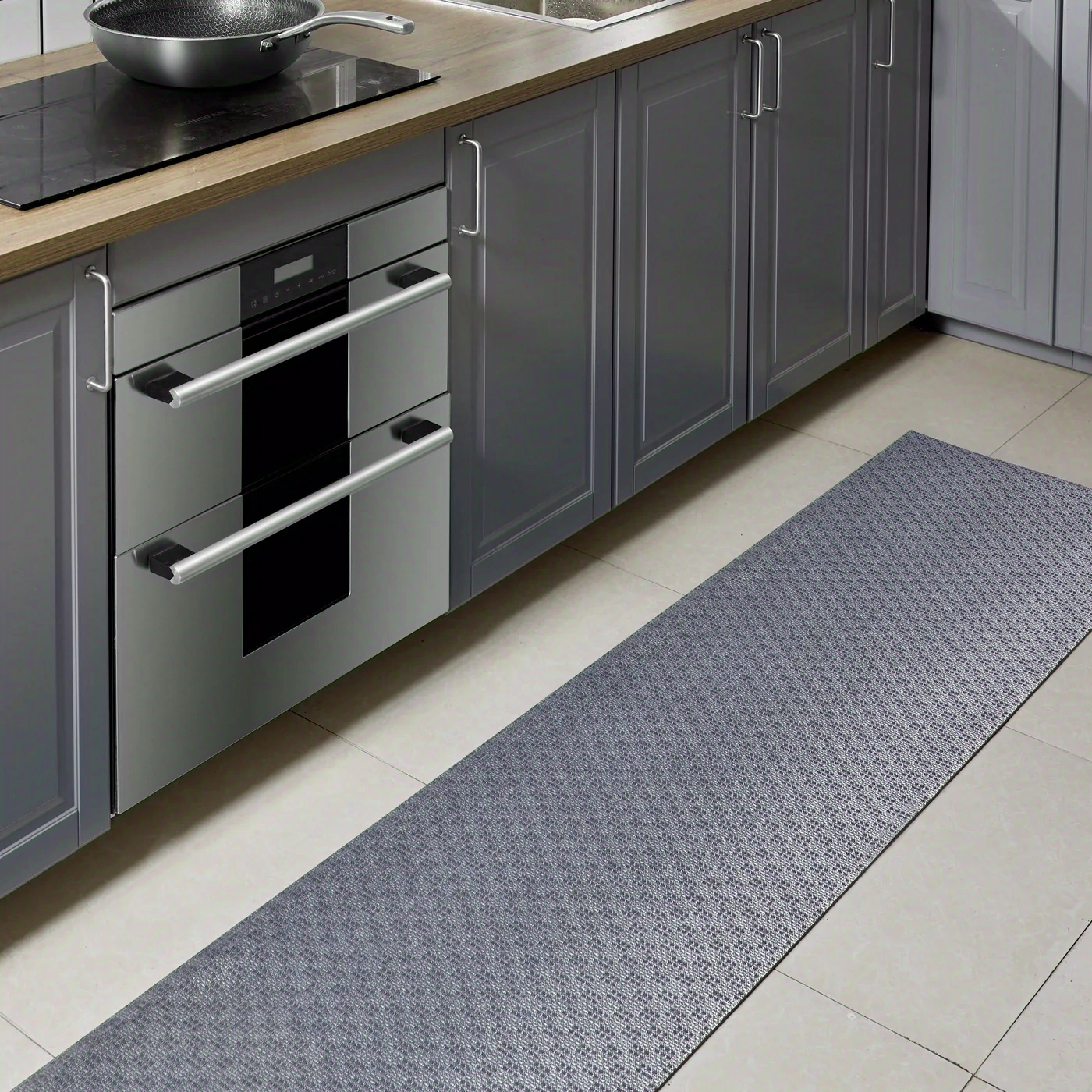

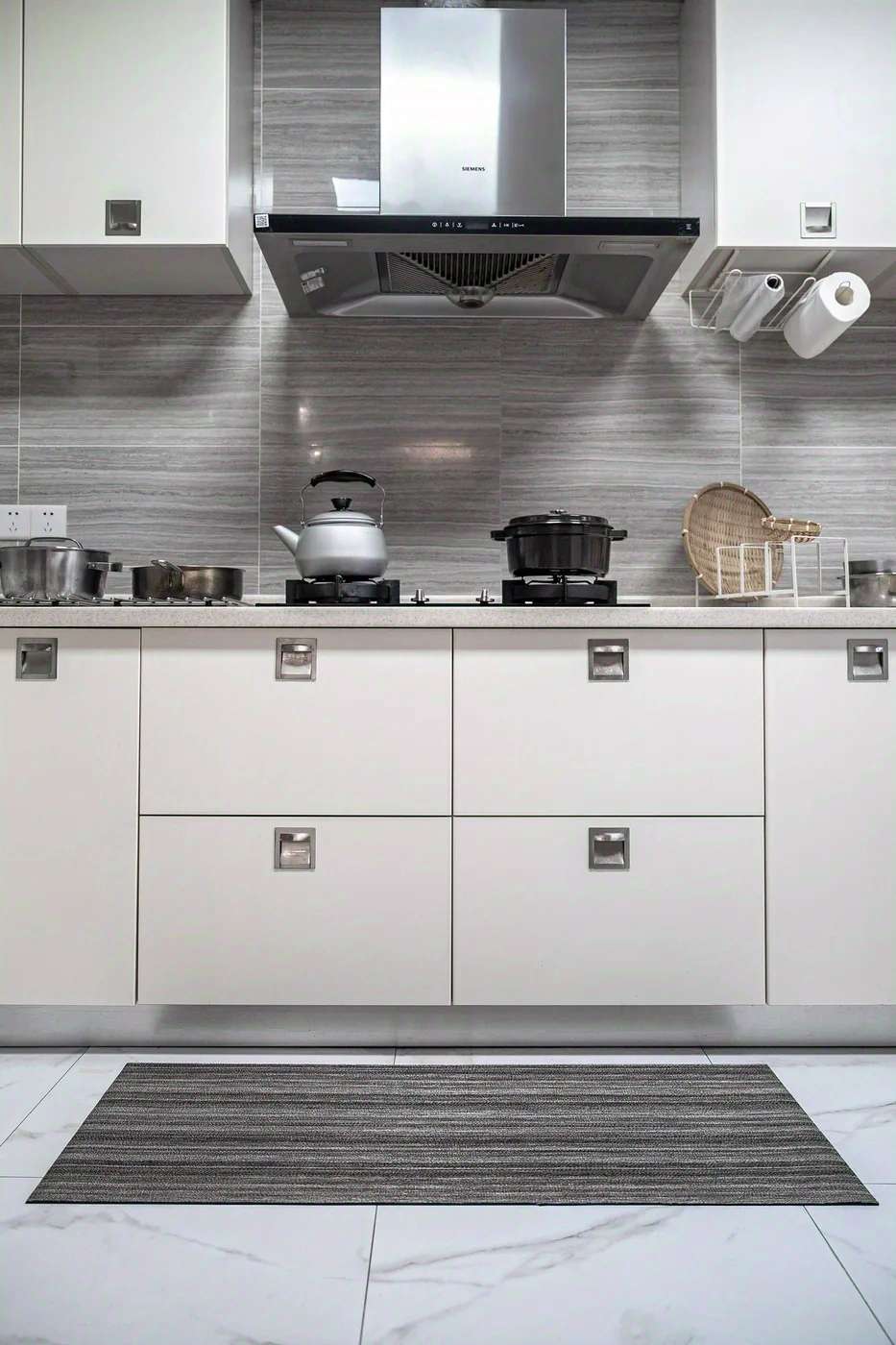


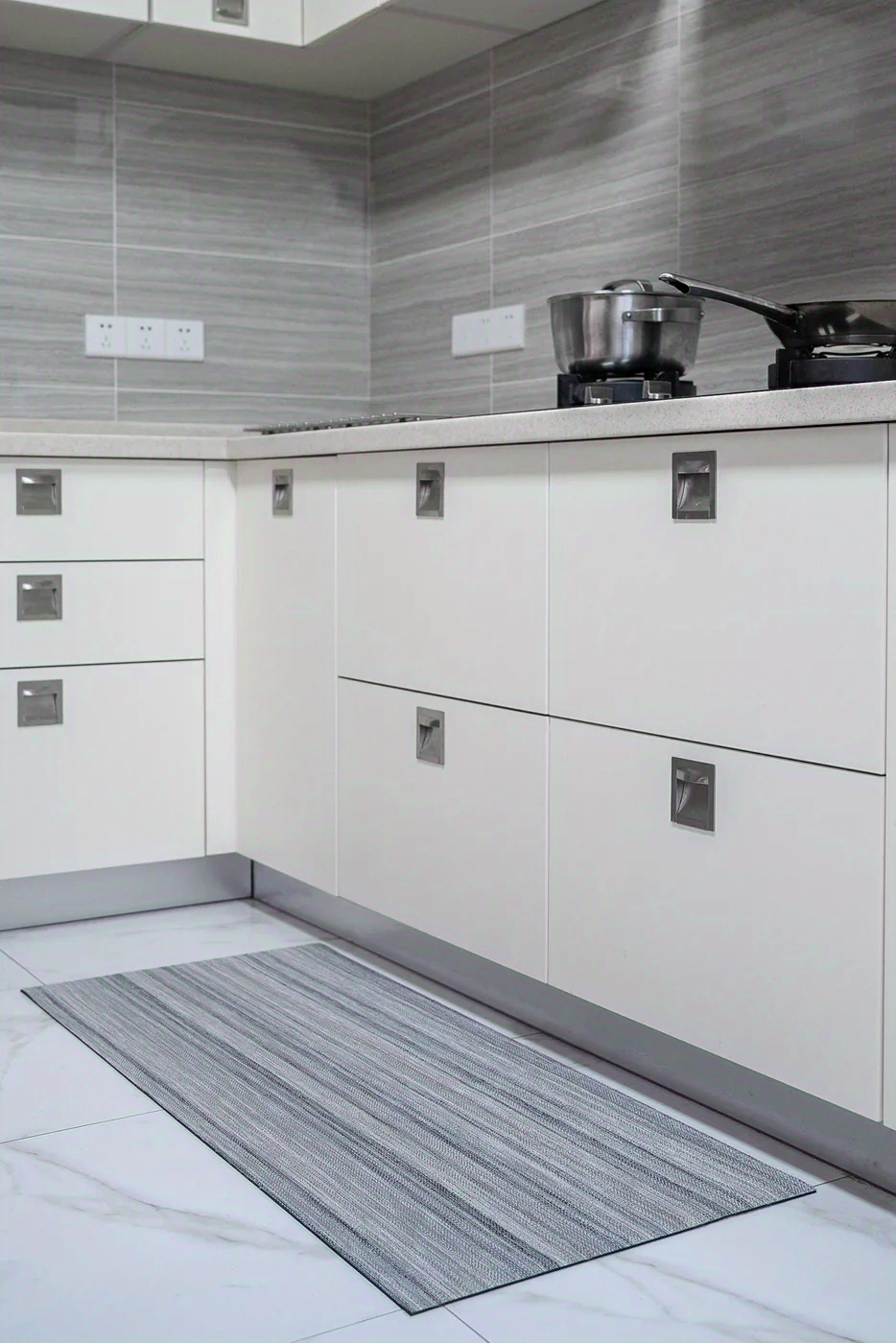


texlymat mats and runners are finished pieces rather than a floor covering: they arrive cut, edged and ready to lay, with no adhesive and no fitting. That makes them the practical option at an entrance, in a hallway, in front of a kitchen run or a bar, in a bathroom, and on a patio or balcony where a woven surface is wanted outside. Because they can be lifted and moved, they also suit rented space and event use. The build is the same as the flooring: a 1.0 mm woven vinyl face on a 3.0 mm PVC foam backing, 4 mm in total at 2,400 gsm, supplied as door mats, area rugs, runners and patio mats. Standard sizes cover most openings, and custom sizes are cut to order. Runners are the same build as the mats, cut to a length that suits the corridor they are ordered for.
The job of a mat is to stop dirt before it reaches the floor, and to stay where it is put. Slip resistance measures 0.50, Class DS under BS EN 13893, and R10 under DIN 51130, which is the figure a specifier asks for in a wet entrance. The backing is not surface-treated, so the mat grips rather than slides on a smooth floor, and the 4 mm build at 2,400 gsm gives enough weight that it stays flat with traffic crossing it. Because the face is a woven vinyl rather than a pile, grit sits on the surface and can be shaken out or vacuumed instead of being worked into the fibre. The same material means a mat can carry the colour of the floor it stands on. Both slip figures are printed on the specification sheet, so they can be copied straight into a tender document without a phone call.
Values below are taken from the official texlymat® rug and mat specification and data sheet. Certificate No. 156 and the test data on file are on the Certifications page.
| Characteristic | Test method | Result |
|---|---|---|
| Classification | EN 1307:2014+A3:2018 / ISO 10974 | Class 23/33, heavy domestic / heavy commercial |
| Dimensional stability | ISO 2551 | Shrinkage 0.4% |
| Skew and bow | EN 427 | < 1% |
| Slip resistance | BS EN 13893 / DIN 51130 | 0.50: Class DS / R10 |
| Castor chair resistance | EN 985, Test A | r = 5, continuous use |
| Surface change (hexapod) | BS ISO 10361 | 5 after 12,000 cycles |
| Pilling (Lisson) | BS EN 1963, Tests A&D | 4.5 |
| Stain resistance | BS EN 423 | Rating 0, not affected |
| Water tightness | EN 15115 | 5, split water / 5, subsequent soiling |
| Light ageing (UV exposure) | ISO 4892-3:2016 Cycle 1, UVA-340, 1,000 h | Grade 4 |
| Thermal conductivity | ISO 8301 | 0.072 W/m·K: 0.046 (m²·K)/W |
| Reaction to fire | EN ISO 9239-1 / EN ISO 11925-2 | Pass: Cfl-s1, d0 |
| Fungus resistance | ASTM G21-13 | Grade 0 |
| Colour fastness to light | BS EN ISO 105-B02:2014 | > 6 (blue wool scale) · TÜV SÜD 70.404.18.21948.01-00 |
| Colour fastness to rubbing | BS EN ISO 105-X12:2016 | Wet 4/5, dry 5 · SGS HZ1293415/TX |
| Colour fastness (change in colour / staining) | BS EN ISO 105-E01:2013 | Change in colour 4/5, staining 4/5 |
| Electrical propensity | ISO 10965:2011 | Horizontal 6.8 × 10¹⁰, vertical 1.6 × 10⁹ |
| Antistatic behaviour | ISO 6356 | See Certifications for the measured value |
| Sound insulation | BS EN ISO 10140-3:2010 | ΔLw 21 dB |
| Sound absorption | EN ISO 354 | αw 0.05, not classified |
| Pentachlorophenol (PCP) | CEN/TS 14494 | Not detected |
| Formaldehyde emission | EN 717-2 | E1: 0.122 mg/m³·h |
| Phthalates (DEHP, DBP, BBP, DIBP) | REACH Annex XVII, entries 51 & 52, (EU) 2018/2005 | Pass |
| REACH | REACH Regulation, 211 substances | Pass |
| RoHS | EU RoHS Directive 2015/863 | Pass |
| AZO | ISO 14362-1:2017 | Pass |
| GB 8624 | GB 8624-2012 | B1 (C-s1) transparent / B1 (B-s1) opacity |
Indicative values from production testing; the report of record travels with each delivery.
Methods, standards and the reports behind these figures: Techniques →
Routine care is a vacuum and a damp mop with a neutral cleaner: no waxing, no polishing, no stripping cycle.
Full cleaning schedules, chemicals and spot guidance for this line: Techniques →
Ordering for trade is normal here rather than an exception. We quote a bulk woven vinyl floor mat and wholesale woven vinyl runner order from a single container upwards, and the same line produces private label floor mats for distributors who sell under their own brand — own brand floor mat production, custom size, custom colour and a custom logo mat are all part of the same programme, because the weave, the backing and the finishing happen on one site.
The backing is a 3.0 mm PVC foam, not a sponge core. That difference is the reason to compare a sample of each: a foam backing holds its thickness under load and finishes cleanly at the cut edge, where a sponge mat compresses and crumbles. If a client is weighing a sponge floor mat against this, the honest comparison is thickness after a year, not price on the day.
Yes. The yarn is UV-stabilised and the mats can be hosed down. The woven face is waterproof, so rain does not damage the mat. At the cut edges the PVC foam backing takes up water slowly, which means a mat can stay damp for a while after heavy rain and then dries in the air. Wetting and drying repeatedly does not harm it, so mats can stay outdoors all season..
Warm soapy water, then a good rinse. Do not machine wash and do not dry clean.
Slip resistance measures 0.50, Class DS (BS EN 13893) and R10 (DIN 51130). The backing is not treated for slip resistance when wet, so take care in wet areas.
Yes, a fitter can cut the material with a sharp knife if a size needs adjusting on site.
Normal underfloor heating temperatures, around 40 °C, are fine. On a freshly painted floor, let the paint cure first, vinyl backing and uncured paint can react and discolour the floor.
Yes. Door mats, area rugs, runners and patio mats, plus any customer size.
A4 swatches are available to qualified distributors and specifiers; samples are free of charge, with the courier at your cost (freight collect). Tell us which collections you are working with and we will send the closest matches.
Yes. Bulk mat and runner orders start from one container, and private-label production starts at 1,000 m² per colour. Labels, sizes, edges and packaging are set with the order.
A 3.0 mm PVC foam backing rather than a sponge core. It keeps its thickness under load and cut edges stay clean; a sponge mat is compressible and degrades at the edge. Samples of both are available if a client wants to compare.
A rug is the same weave cut to a size instead of being laid wall to wall. What changes is the edge and the format: a finished border, a defined shape, and no welding to anything. That makes it the practical answer where a floor has to change character without being replaced: a hotel suite over a hard floor, a showroom display that moves twice a year, a bedroom that wants warmth in one place.
Rugs are cut from the 200 cm roll (±1%, EN 426), so the size is limited by the roll width rather than by a quantity. Edges are bound or overlocked; ask for both samples, because the difference is invisible at 30 cm and obvious at three years. On a smooth hard floor a non-slip undersheet keeps the rug from creeping along a walk line.
Stock qualities carry no minimum order and ship in 2 to 3 weeks; made-to-size rugs are cut from stock, so the constraint is width. Unique designs made to your own specification start at 1000 m² and run 4 to 6 weeks.
Buying for resale rather than specifying? · Become a distributor · OEM and private label.