
When a Pipe Bursts in a Finished Office
A pipe failed above a finished office fit-out. By the following morning there was standing water in the corridor and in the two rooms off it, a few millimetres deep and still spreading. The floor was ours: 4 mm wall to wall woven vinyl at 2,400 gsm, laid in 200 cm rolls.
The water was cleared the next day with a wet vacuum and cloths. Nothing was lifted and nothing was replaced. The photographs below were taken while the water was still standing, and again after the floor had dried.
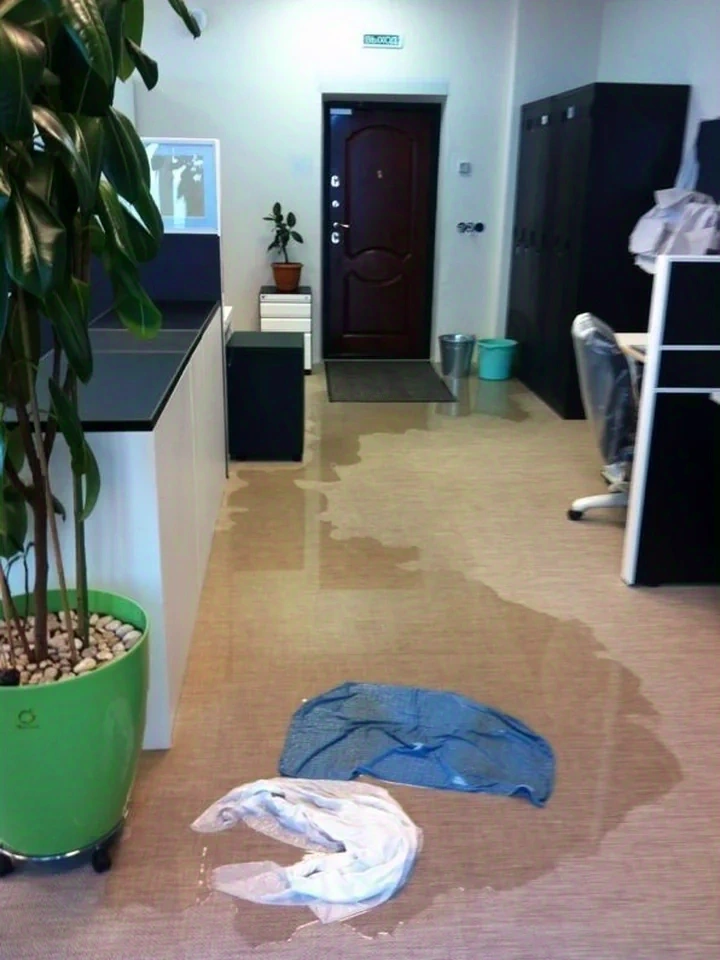
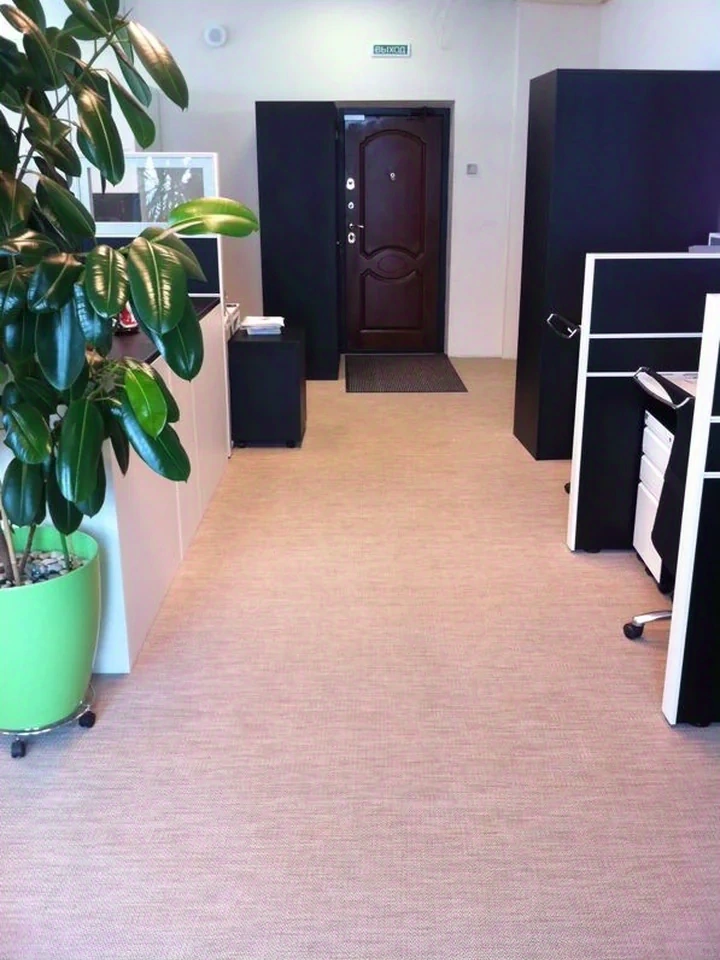
What the water actually did
Water behaves on a woven surface in a way that surprises people used to laminate or carpet. It does not sit on top like a puddle on glass, and it does not soak in like a sponge. It runs across the weave, collects in the small valleys of the texture where the floor is not quite level, and where it stays long enough it passes through the open weave to the backing underneath. What it reaches there is a closed-cell PVC foam, and what it has passed through is yarn already coated in PVC. Neither material takes water into its structure, so nothing swells and nothing has to be dried out from the inside. When the standing water was removed, the surface dried from the edges inward within a few hours, and there was no smell afterwards, which is the usual giveaway when water has been held inside a floor.
Does woven vinyl absorb water?
No. The yarn is a high-tenacity core coated in PVC before it is woven, so the fibre inside never meets water. The backing on a wall to wall construction is a 3.0 mm closed-cell PVC foam, and on the modular and acoustic ranges a PVC backing with fibreglass reinforcement and a felt layer. None of these is hygroscopic, which is the property that makes a floor swell, cup at the seams or delaminate after a leak. Colour sits in the yarn rather than on the surface, so there is no printed layer to lift or blush. Water passes through the open weave to the backing and stays there until it is removed or evaporates, and the floor returns to its original thickness because it never gained any. Where this page says waterproof it means the yarn and the backing on their own; where it says water resistant it means the finished floor, seams and subfloor included. Both are true at once.
Why does a woven vinyl floor not swell at the seams?
Because swelling is a property of materials that absorb water, and none of the layers does. A laminate board swells at its joints because the core is wood fibre, and once that core has taken water it never returns to its original thickness. A woven vinyl floor has no wood fibre, no paper and no natural yarn anywhere in the construction, so there is nothing in it to expand. The face is PVC-coated strand yarn, the core is high-tenacity polyester or fibreglass, and the backing is PVC foam. A polyester core can carry water along the yarn in theory, but it is encapsulated on all sides by the coating, which is why a wet floor dries rather than wicks. What can still fail at a seam is the adhesive line or a butted joint, and that is a question about the installation rather than the material.
The first 24 hours after a leak
The order matters more than the method. Water moved out in the first few hours costs a morning of labour; water left to find its way under a floor, into a skirting board and up a plasterboard wall costs a fit-out.
- Stop the source and isolate the electrics. Nothing else on this list matters until both are done.
- Photograph the water before clearing it. Depth against a door frame or chair leg is enough. Insurers ask, and so do we when a client wants a written assessment.
- Extract standing water, do not sweep it. A wet vacuum, working from the dry side towards the source.
- Lift loose-lay tiles, leave sheet down. Tiles dry standing on edge; a glued sheet stays where it is, because lifting does more harm than the water.
- Ventilate, and add a dehumidifier if there is one. Air movement at skirting level does most of the work.
- Check what else the water touched. MDF skirting, plasterboard, joinery and stored board swell and stay swollen.
- Call us if the water came from a drain or stood for over 48 hours.
What should be done first when a floor floods?
Stop the water and make the electrics safe, then photograph the extent before anything is moved, because that record is what an insurer and a contractor will both ask for. After that, extract standing water rather than sweeping it, so the wet area does not grow, and get air moving at skirting level where water collects unseen. Lift loose-lay modular tiles and stand them on edge to dry; leave a glued sheet floor in place, since lifting damages the adhesive line and the seams for no gain. Then look past the floor at what else took water: MDF skirting, plasterboard, joinery and stored board are the materials that fail, and they fail whether the floor is ours or anyone else's. A woven vinyl floor needs no drying regime of its own. It needs the water removed and the room ventilated, and it is back in service once the surface is dry.
How other floors behave in the same incident
None of this is an argument against other materials. It is a description of what each one does with water, so a specification can be written against the risk of a building rather than the impression a showroom gives.
| Material | What water does | What it usually means |
|---|---|---|
| Laminate | The HDF core takes water at the joints and swells. | Boards lift at the seams and cannot be flattened. Replacement of the affected area. |
| Luxury vinyl tile | The tile is stable; water reaches adhesive and subfloor through seams and perimeter. | Often recoverable, but affected tiles are relayed and the subfloor dried. |
| Carpet tile and broadloom | Pile holds water; backing and adhesive stay wet for days. | Extraction and drying equipment on site, with the risk of odour in the backing. |
| Woven vinyl | Water passes the open weave to a closed-cell PVC backing; no absorption, no swelling. | Water removed and the room ventilated. Floor stays in place and dries. |
Where water resistant stops
The photographs are the argument for the material, but they are not a warranty against water. A woven vinyl floor is a water resistant surface over a building, not a waterproof tank, and the distinction matters most in exactly the buildings where floors get wet. Because the weave is open, water that stays on the floor reaches the backing and then, at seams and at the perimeter, the subfloor. A screed or a plywood deck will tolerate one incident that is dried out. It will not tolerate water left for a week under a sheet floor, and no floor covering can promise otherwise. The same is true of what the water touches on the way up: an MDF skirting, a plasterboard wall and a joinery plinth all swell and stay swollen, and those are what a client usually ends up replacing after a flood.
What does water resistant not cover?
It does not mean the floor is a sealed membrane, and it does not mean water can stand on it indefinitely. The weave is open by design, so water passes through to the backing and then to whatever the backing sits on; in a building with a moisture-sensitive subfloor the floor can be perfectly intact while the subfloor beneath it is not, and that is the failure a client discovers later. Seams are the second line to watch, because a welded seam is continuous and a butted one is a joint, and long standing water will find the difference. Third, the floor does not protect MDF skirting, plasterboard or joinery, which swell on contact. Flooding, drain water and long standing water sit outside what a flooring warranty covers, and we assess those cases with the client rather than around them. What the material does promise is narrower: no absorption, no swelling, no replacement after a single wet night.
Specifying for buildings that will get wet
Most of the decisions that decide how a floor behaves in a leak are made at specification, not at the mop.
- Roll width. A 200 cm roll runs a standard corridor without a lengthways join, which removes a seam from the path water would take.
- Sheet or tile. A glued sheet gives the fewest seams; modular tiles lift for drying and for access to services, at the cost of more joints.
- Seams. Specify welded seams in wet-risk areas. A butted seam is faster and looks identical on day one.
- Subfloor. Find out what is under the floor before choosing what goes on it. A floor covering cannot dry a deck that is holding water.
- Perimeter and risers. Carry the floor up the riser where water is likely, and keep MDF away from the wet line.
- Access. In plant rooms and kitchens, loose-lay tiles over an access floor are worth the extra joints when a pipe fails on a Sunday.
For the construction numbers see wall to wall woven vinyl; for the comparison against LVT and carpet tile in a contract specification see choosing a contract floor. The documents a client should hold before a project starts are listed on resources.
What one incident proves, and what it does not
This is a field observation, not a laboratory result. There is no standard test for a building flood, and two photographs are not one. What can be stated is what the material is made of and what the documents say: CE marking to EN 14041 (certificate 156) for the wall to wall range, EN 15102 (certificate 157) for wallcovering, reaction to fire Cfl-s1 on the 4.1 mm construction, colour fastness to BS EN ISO 105-B02 and B-04 at grade 4–4.5, and a current REACH SVHC declaration. Those are the numbers a specifier can check. What the photographs add is the part a data sheet cannot show: what a floor looks like the morning after, when a building is open and a client is asking whether the fit-out has to come out.
Ask before the floor is laid
If a project has a specific wet risk, send the drawing and the subfloor build-up. We would rather discuss the seam detail before the floor goes down than after a pipe fails. Contact the technical team, or request a swatch to handle the surface yourself.
Read the FAQ entry: is woven vinyl waterproof and slippery when wet?