
Woven Vinyl Wall to Wall Flooring
Request a quote →Sample book and A4 swatches available — Request a swatch kit · stock items carry no MOQ
Woven vinyl wall to wall flooring: the look of textile, the easy care of vinyl. Cold-welded seams; a 3.0 mm vinyl cushion backing cuts impact noise by ΔLw 21 dB. It is specified for hotel corridors and guest rooms, offices, retail space and residential floors.
Specifications
| Property | Specification | Test method |
|---|---|---|
| Surface | 1.0 mm woven vinyl | — |
| Backing | 3.0 mm vinyl cushion | — |
| Total thickness | 4 mm | ISO 1765 / EN 428 |
| Total weight | 2,400 gsm (average) | ISO 8543 / EN 430 |
| Construction | Woven vinyl fibre, tightly woven for strength and fray resistance. high-tenacity polyester core yarn as standard; a fibreglass core is available for broader applications. | — |
| Design options | Sisal and linen looks, from neutral tones to bolder colourways | — |
| Roll width | 200 cm (±1%) | EN 426 |
| Roll length | 15–25 m per roll | EN 426 |
| CE marking | EN 14041:2004+AC:2006: Certificate of Conformity No. 156 | see Certifications |
| Installation | Wall to wall, backing bonded and seams cold-welded | — |
| Maintenance | Vacuum or damp mop | — |
Specifications are taken from the official specification sheet for this product line. Rolls are a minimum of 200 cm wide; wider and exceptional widths, and custom lengths, can be considered on request.
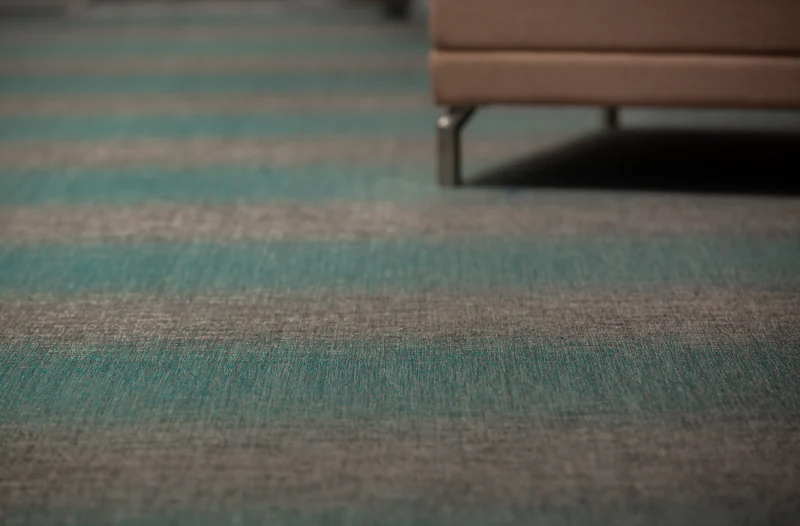
Roll widths, and what contract work needs
Most contract work starts with a width question. Our woven vinyl flooring comes in 200 cm rolls (±1%, EN 426), 15 to 25 m long, which covers a hotel corridor or a classroom without a lengthways seam. Where a room is wider than the roll, the join is cold-welded rather than butted, so soil has nowhere to collect.
If a project needs a wider sheet, send the room dimensions with the enquiry. We would rather say what the material can do than quote a width that will not arrive.
| Property | Value |
|---|---|
| Roll width | 200 cm ±1% (EN 426) |
| Roll length | 15–25 m per roll |
| Total thickness | 4 mm |
| Total weight | 2,400 g/m² |
| Seams | Cold-welded; no stitch line, nothing for soil to collect in |
Where this surface works
- Hotel corridors and guest rooms High-traffic areas where a floor has to keep its looks between refurbishments.
- Offices and reception floors One continuous surface from the lift lobby to the meeting rooms.
- Retail and showroom space A calm base that lets the merchandise lead.
- Healthcare and education Wipe-clean, low-allergen floors for hospitals, clinics, classrooms and libraries.
- Residential interiors Living areas, bedrooms, kitchens and basements that keep the look of a woven textile.
Which interiors does wall to wall flooring suit?
Woven vinyl wall to wall flooring is specified where a floor is seen as well as used. In hotels it goes into guest rooms, corridors and lobbies, because the same surface carries a woven texture into the bedroom and survives trolley traffic in the corridor. In offices it runs from the lift lobby to the meeting rooms without a change of material, which is what makes an open floor read as one space. In retail it stays quiet under the merchandise. In hospitals and schools the wipe-clean face and the absence of pile matter more than the look, and in homes the 4 mm build at 2,400 gsm gives the warmth of a textile with the care of a vinyl. The construction is a 1.0 mm woven vinyl face on a 3.0 mm PVC foam backing, in rolls of at least 200 cm, cold-welded on site.
What this surface does well
- Material and construction Vinyl-coated fibres are woven tight for strength and fray resistance.
- Design versatility Sisal and linen looks, from neutral tones to bolder colourways.
- Impact noise The 3.0 mm vinyl cushion backing cuts impact noise by ΔLw 21 dB to BS EN ISO 10140-3:2010, which helps in corridors, open offices and on upper floors.
- Quick wall to wall installation Rolls are laid over the subfloor with the backing bonded to the substrate, and the joints are cold-welded through both the woven face and the PVC backing, so the seam sits flat and stays closed.
What does it actually do well?
Three properties do most of the work. The face is a woven vinyl, so it looks like a textile and mops like a vinyl sheet, with no wax, no stripping and no extraction machine. The 3.0 mm PVC foam backing absorbs impact: our SATRA report 4343-3975 records ΔLw 21 dB on the construction tested to BS EN ISO 10140-3:2010, which is the figure that matters in corridors, open offices and on upper floors. And the seam is cold-welded through both the woven face and the PVC backing, so the floor reads as one continuous surface with no raised trip edge. Castor use is rated r = 5 under EN 985 Test A for continuous use, and colour fastness is tested to BS EN ISO 105-B02 and B-04 at grade 4 to 4.5. The same figures appear on the specification sheet and in the test reports held on file, so a specifier can check each one against the certificate rather than taking a brochure at its word.
Tested performance, with the methods behind it
Values below are taken from the official specification sheet and the test reports held on file. Where a characteristic is shown on a certificate, the certificate is the reference.
| Characteristic | Test method | Result |
|---|---|---|
| Classification | EN 1307:2014+A3:2018 / ISO 10974 | Class 23/33, domestic heavy / commercial heavy |
| Dimensional stability | ISO 2551 | Shrinkage 0.4% |
| Skew and bow | EN 427 | < 1% |
| Slip resistance | BS EN 13893 / DIN 51130 | 0.50: Class DS / R10 |
| Castor chair resistance | EN 985, Test A | r = 5, continuous use |
| Surface change (hexapod) | BS ISO 10361 | 5 after 12,000 cycles |
| Pilling (Lisson) | BS EN 1963, Test A&D | 4.5 |
| Stain resistance | BS EN 423 | Rating 0, not affected |
| Water tightness | EN 15115 | 5, split water / 5, subsequent soiling |
| Colour fastness to light | BS EN ISO 105-B02 | > 6 (blue wool scale) · TÜV SÜD 70.404.18.21948.01-00 |
| Colour fastness to rubbing | BS EN ISO 105-X12 | Wet 4/5, dry 5 · SGS HZ1293415/TX |
| Light ageing (UV) | ISO 4892-3, UVA-340, 1,000 h | Grade 4–5 |
| Thermal conductivity | ISO 8301 | 0.072 W/m·K, thermal resistance 0.046 m²·K/W |
| Reaction to fire | EN ISO 9239-1 / EN ISO 11925-2 | Pass, classification Cfl-s1, d0 |
| Antistatic behaviour | ISO 6356 | See Certifications for the measured value |
| Sound insulation | BS EN ISO 10140-3:2010 | ΔLw 21 dB |
| Sound absorption | EN ISO 354 | αw 0.05, not classified |
| Fungus resistance | ASTM G21-13 | Grade 0 |
| Electrical propensity | ISO 10965:2011 | Horizontal 6.8 × 10¹⁰, vertical 1.6 × 10⁹ |
| Pentachlorophenol (PCP) | CEN/TS 14494 | Not detected |
| Formaldehyde emission | EN 717-2 | E1: 0.122 mg/m³·h |
| Colour fastness (change in colour / staining) | BS EN ISO 105-E01:2013 | Change in colour 4/5, staining 4/5 |
| Phthalates (DEHP, DBP, BBP, DIBP) | REACH Annex XVII, entries 51 & 52, (EU) 2018/2005 | Pass |
| REACH | REACH Regulation, 211 substances | Pass |
| RoHS | EU RoHS Directive 2015/863 | Pass |
| AZO | ISO 14362-1:2017 | Pass |
| GB 8624 | GB 8624-2012 | B1 (C-s1) transparent / B1 (B-s1) opacity |
Indicative values from production testing; the certificate or test report prevails.
What matters on site
- Trim the selvage Trim 2–3 cm in from the edge before installation.
- Never mix batches texlyweave® is a woven fabric, so tonality can vary slightly from one production batch to the next. Each roll label carries its batch number, finish one batch before starting the next, and use the same batch within one space.
- Laying Installed as broadloom with the backing bonded to the substrate and the seams cold-welded, so the floor reads as one surface with no raised trip edges.
- Use an experienced fitter Woven vinyl needs a professional installer. We can advise on subfloor preparation and laying sequence.
- Waterproof material, permeable construction Water tightness tested to EN 15115 (rating 5, split water): water does not damage the material or leave a stain, but the weave lets it through, so wipe standing water up before it reaches the subfloor.
What goes wrong on site, and how is it avoided?
Everyday maintenance
- Routine Vacuum as normal; damp mop with a neutral cleaner. No waxing, no polishing.
- Spills Blot, don’t rub. Most spills lift cleanly, stain resistance is rated 0 (not affected) to BS EN 423.
- Common spots Adhesive tape: harden with ice, rub off. Alcoholic drinks: cold water, then white vinegar, then rinse. Butter or grease: hot water. Chewing gum: ice, then cold water. Blood or ketchup: cold water, diluted ammonia, then rinse thoroughly.
- Avoid Abrasive pads, aggressive solvents and steam. Chair castors are rated for continuous use, but protective mats are sensible under heavy castor traffic.
What does maintenance involve?
Custom and special orders
- Custom designs Unique designs can be developed for your project. Minimum order 1,000 m².
- Special widths and lengths Available on request; the pallet system is affected, so please plan with us early.
- Two core systems high-tenacity polyester core as standard, fibreglass core for broader application and longer-term development needs.
- Cut-and-bound rugs and mats The same woven vinyl is available as rugs, mats and runners if you want one material across a whole project.
- Sample swatches A4 swatches are available to qualified distributors and specifiers; samples are free of charge, with the courier at your cost (freight collect).
Wall to wall flooring: questions we get asked
Is texlyweave® flooring waterproof?
The material is waterproof, and the floor is not a sealed membrane. Vinyl-coated yarn and the PVC backing do not absorb water, so the floor does not swell, rot, delaminate or lose colour when it gets wet, and it can be mopped or left damp without damage. What it does not do is act as a barrier: the face is woven, so water passes through the weave instead of beading on it, and on an indoor floor standing water left for a long time can reach the subfloor at a seam. Wipe pooled water up when it happens; a damp floor is how this product is meant to be cleaned. Water on the surface does not turn it slick the way it does on a smooth vinyl sheet, because the woven face stays textured underfoot. On the mat range we test that: slip resistance measures 0.50, Class DS to BS EN 13893 and R10 to DIN 51130.
Is it soft to walk on?
Yes. The 3.0 mm vinyl cushion backing makes it soft underfoot and quiet compared with a hard PVC-backed floor covering, while the woven surface takes heavy traffic.
Can it be used with office chairs on castors?
Yes. Castor chair resistance is rated r = 5 for continuous use (EN 985, Test A). Under very heavy castor traffic we still recommend protective chair mats.
Can it be laid over underfloor heating?
We have practical experience rather than a laboratory result for this. Woven vinyl comfortably withstands around 40°C, so a heating system running at that temperature is not a problem.
Can a damaged area be repaired?
Yes. A patch of the same pattern is laid over the damaged area, both layers are cut through together, and the new piece is bonded in, so the repair is invisible and no whole roll is wasted.
What does the batch number on the roll label mean?
It identifies the production batch. Only use rolls with the same batch number within one space, and finish one batch before starting the next.
How do I get samples?
Write to info@dragonshine.net or use the contact form. Swatches are available to qualified distributors and specifiers; samples are free of charge, with the courier at your cost (freight collect).
Collections available in this surface
GRANITO · GRAINY · RANDOM · HERRINGBONE
Choosing a contract floor? The selection guide compares woven vinyl with LVT and carpet tile on impact noise, cleaning and the documents a project asks for: read the guide →